EV Charger Installation guide
How Do You Get Strata Approval for an EV Charger in a Brisbane Apartment?
How Do You Get Strata Approval for an EV Charger in a Brisbane Apartment?
Getting strata approval for an EV charger is possible, but it takes patience and the right paperwork. In most cases you will need a formal written resolution from your owners corporation before any electrical work can start. The good news is that Queensland's strata legislation has been moving in a more EV-friendly direction, and many Brisbane bodies corporate are approving these requests when they are presented properly.
Here is what the process actually looks like, step by step.
Understanding Who Actually Owns What in Your Building
Before you write a single word to your body corporate, get clear on the distinction between lot property and common property. Your car space is almost certainly common property, even if it has been allocated exclusively to your lot. The same typically applies to the switchboard risers, the car park structure itself, and any conduit runs through the building.
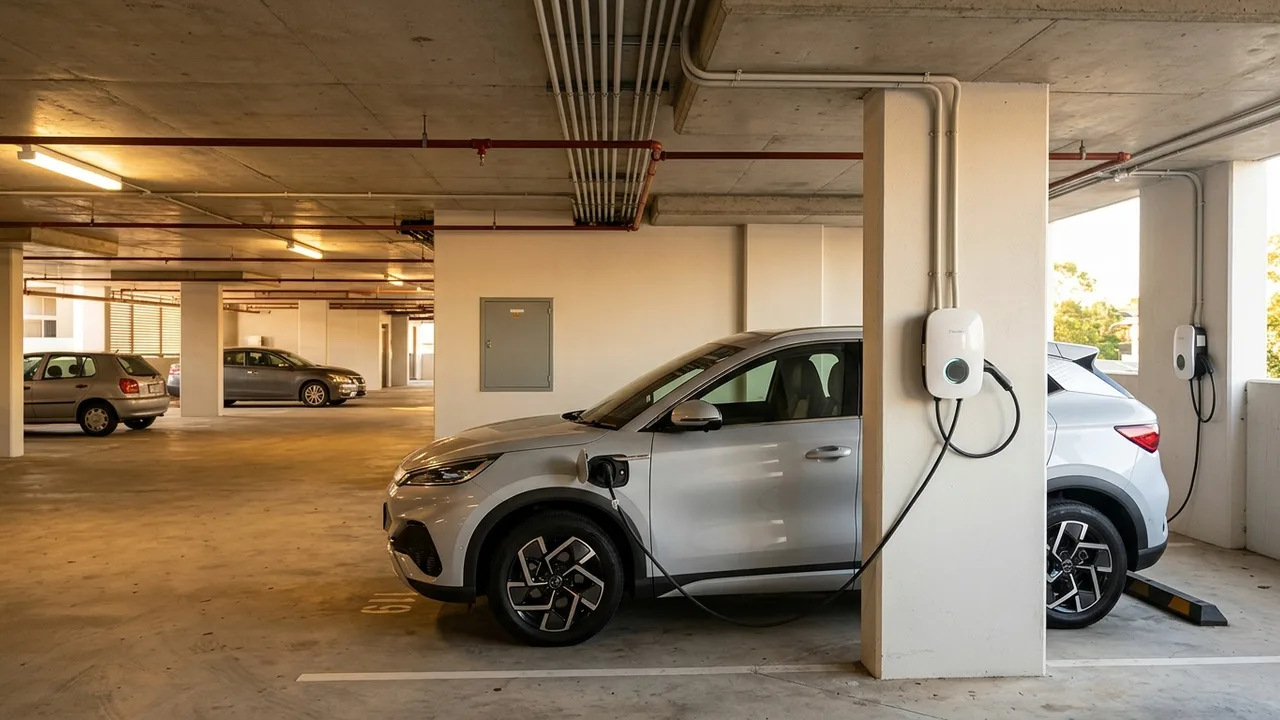
This matters because works on common property require a different level of approval than works entirely within your lot. A wall charger mounted inside a dedicated garage that is defined as lot property in your community management statement may need only a motion by the committee. Anything that touches common property, including running a new circuit from a common switchboard, will generally require a general meeting resolution.
Pull your community management statement from the Queensland Titles Registry if you do not already have a copy. It is a free search. Look at how your car space is defined. That one document will save you weeks of back-and-forth.
What Queensland Law Says Right Now
Queensland's Body Corporate and Community Management Act 1997 and its associated regulation modules govern this. As of mid-2024, there is no Queensland-specific "right to charge" law equivalent to what some other states have introduced, so you are working within the standard improvement and alteration approval process.
What this means practically is that your body corporate cannot refuse a reasonable request without grounds, but it is not obligated to approve one quickly either. Resolutions for works on common property typically require a special resolution (75% of votes in favour) or, in some cases, an ordinary resolution depending on how your scheme is set up and the extent of the works.
The Accommodation Module and the Standard Module handle things slightly differently, so confirm which one applies to your scheme. Your scheme manager will know.
How to Put Together a Request That Actually Gets Approved
A vague email saying "I want to put in an EV charger" will likely land in the too-hard basket. A well-structured written request with supporting documents is far more likely to get a yes at the next committee or general meeting.
Include these in your submission:
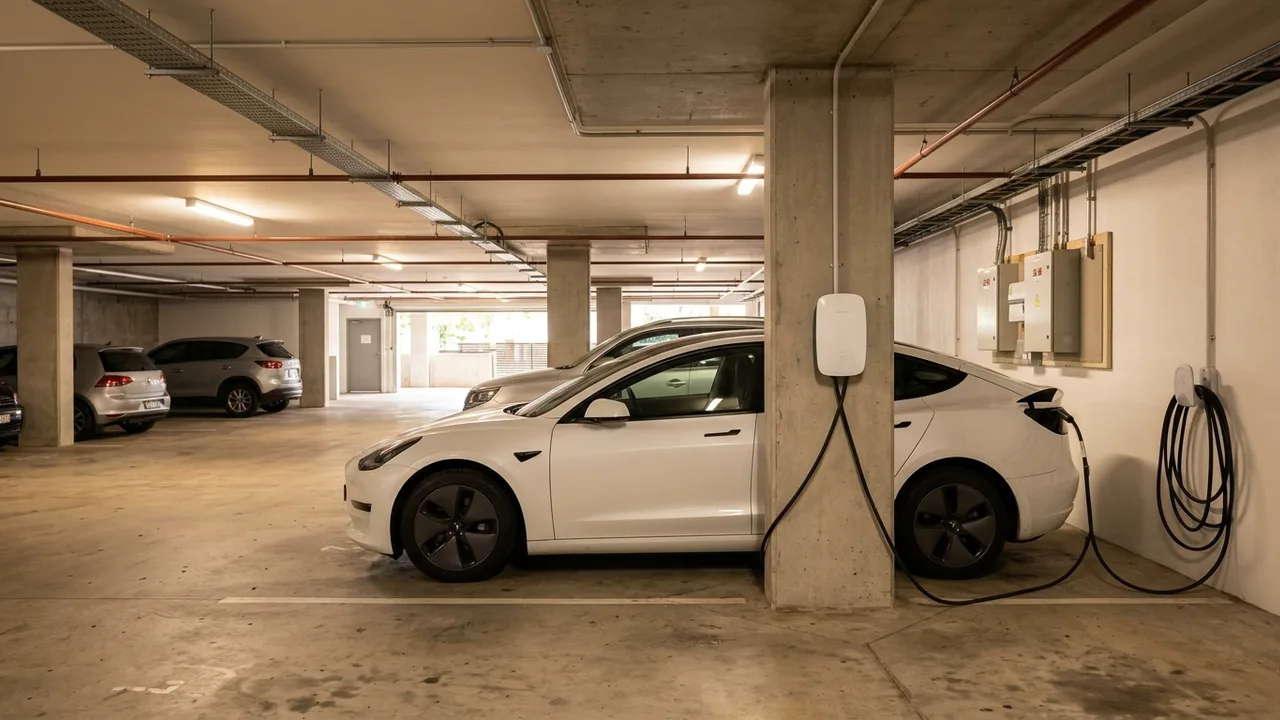
- A clear description of the works. Specify the charger model, its output rating (typically 7.2 kW for a single-phase Level 2 unit), the cable route, and where it will be physically mounted.
- A preliminary quote from a licensed electrician. This shows the committee you are serious and gives them cost context. We are happy to provide this for free for residents across Inner North Brisbane suburbs including New Farm, Teneriffe, Newstead, and Windsor.
- Evidence that costs are borne by you. Make clear that installation, any switchboard upgrades, metering, and ongoing electricity costs are entirely your responsibility.
- A sub-metering or dedicated circuit plan. This is a big one. Bodies corporate are rightly concerned about who pays for the electricity. A dedicated circuit from a separate sub-meter on your lot, or a smart charger with RFID or app-based access control, addresses this directly.
- A restoration clause. Offer in writing to restore common property to its original condition if you sell or the tenancy ends. This removes a common objection.
If your building is a newer high-rise in Newstead or Bowen Hills, it may already have conduit or EV-ready infrastructure in the car park. Check the as-built drawings with the building manager before assuming the worst.
The Electrical Side: What the Installation Actually Involves
Once approval is in hand, the installation process for an apartment EV charger is more complex than a suburban house job, but it is entirely routine for an electrician with strata experience.
The typical scope includes:
- Running a dedicated 32-amp circuit from the switchboard (either your lot sub-board or a new sub-meter on the common switchboard)
- Installing a Type 2 wall-mounted charger in your car space
- Potentially upgrading the metering arrangement so usage is billed correctly to your lot
- Issuing a Certificate of Compliance for Electrical Work (CCEW) from a licensed Queensland electrical contractor
In older buildings around Wilston, Windsor, or Albion, the switchboard infrastructure may be dated. A switchboard upgrade may be required before a dedicated EV circuit can be safely added. That adds cost, typically $800 to $1,500 on top of the charger installation, but it is not optional if the existing board cannot safely support the load.
For a standard apartment installation across Inner North Brisbane, total costs typically fall somewhere between $1,800 and $4,500, depending on cable run distance, metering complexity, and whether any switchboard work is needed.
Shared Charging as an Alternative Worth Considering
If your body corporate is reluctant to approve individual chargers for every unit that asks, a shared charging arrangement is worth raising. This involves the body corporate installing one or more chargers in the common car park as a building-wide asset, with costs recovered through a usage-based billing system or a levy.
This model is increasingly common in medium-density complexes across Inner North Brisbane. It removes the individual approval hurdle and can make commercial sense for the building as a whole. Some charger manufacturers offer dedicated multi-unit residential solutions with load balancing built in, so the building's electrical infrastructure is not overloaded when multiple residents charge at once.
It is a larger conversation to initiate, but if you are in a building where several residents drive EVs, it may be the most practical path.
What to Do If Your Request Gets Knocked Back
A refusal is not necessarily the end. Under the BCCM Act, you have the right to apply for dispute resolution through the Office of the Commissioner for Body Corporate and Community Management (BCCM Commissioner) if you believe the refusal was unreasonable.
Before going down that path, try to understand the specific objection. Is it about electrical capacity? About who pays for the power? About aesthetics or liability? Most objections have practical solutions, and a second, more targeted submission often succeeds where the first did not.
Some residents in older strata schemes around Herston and Kelvin Grove have found success simply by attending the AGM in person and walking the committee through the technical detail. Bodies corporate are made up of your neighbours, not bureaucrats. A clear, confident, non-adversarial conversation often moves things faster than formal correspondence.
A Practical Path Forward
If you are at the start of this process, the most useful first step is a site visit to understand what the electrical infrastructure in your building can actually support. That gives you concrete information to put in front of your body corporate, rather than a vague request.
We work with apartment residents across Newstead, Teneriffe, New Farm, Windsor, Albion, and nearby suburbs. If you want a preliminary assessment of your car space and switchboard before you approach your body corporate, give us a call. Having a real scope and a written quote in hand makes your approval request considerably more credible, and it costs you nothing to find out where you stand.
Quick answers