EV Charger Installation guide
Installing an EV Charger in an Older Queenslander Home Is a Different Job
Installing an EV Charger in an Older Queenslander Home Is a Different Job
Yes, it genuinely is a different job. Older Queenslander homes across Inner West Brisbane were built decades before anyone imagined a 32-amp dedicated circuit running to a carport under the stumps. The wiring, the switchboard, and sometimes the physical layout of the house all create challenges you simply won't find in a 2015 brick-and-tile in the suburbs.
That doesn't mean it can't be done. It means it needs to be planned properly.
Why the Electrical Infrastructure Is Usually the First Problem
Most Queenslanders built before the 1980s were wired for a fraction of the load a modern household runs today. Back then, a 40-amp or 60-amp single-phase service was considered plenty. Add air conditioning, an induction cooktop, a heat pump hot water system, and now an EV charger pulling 7.2 kilowatts (kW) continuously, and you're asking a lot from infrastructure that was never designed for it.
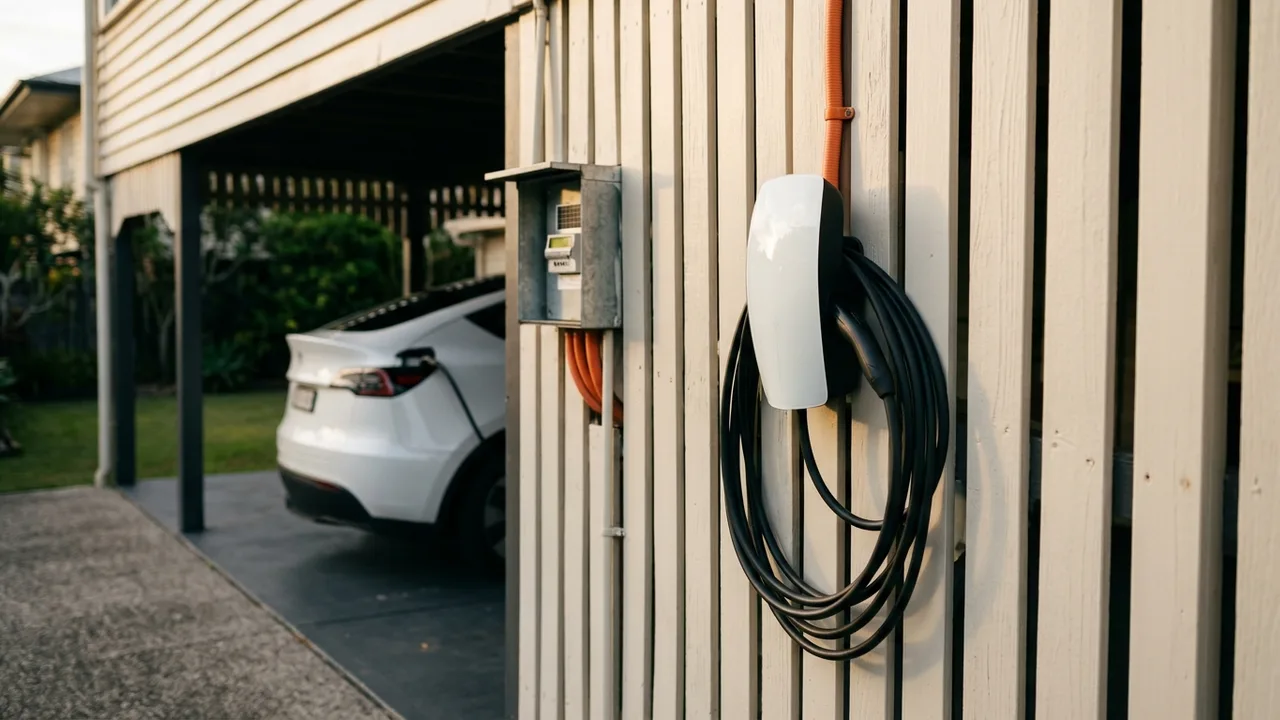
The switchboard is usually the first thing an electrician will look at. Older homes in Windsor, Wilston, and Albion often still have ceramic fuse boards rather than modern circuit breakers. Some have the original single-phase 63-amp service fuse from Energex, which leaves almost no headroom for a dedicated EV circuit once the house load is accounted for.
A switchboard upgrade isn't optional in these cases. It's a safety requirement under Queensland's electrical rules, and it's the foundation everything else sits on. Typically, upgrading an older fuse board to a modern RCD-protected consumer mains unit runs $1,200 to $2,000 on its own, before the charger circuit is even started. That's not a cost to begrudge. It's the part that makes the rest of the job safe and legal.
The Cable Run: Under the House Changes Everything
A standard EV charger installation in a newer home often means running a cable from the switchboard, through a cavity wall, and out to a garage. It's a contained run, usually under 15 metres.
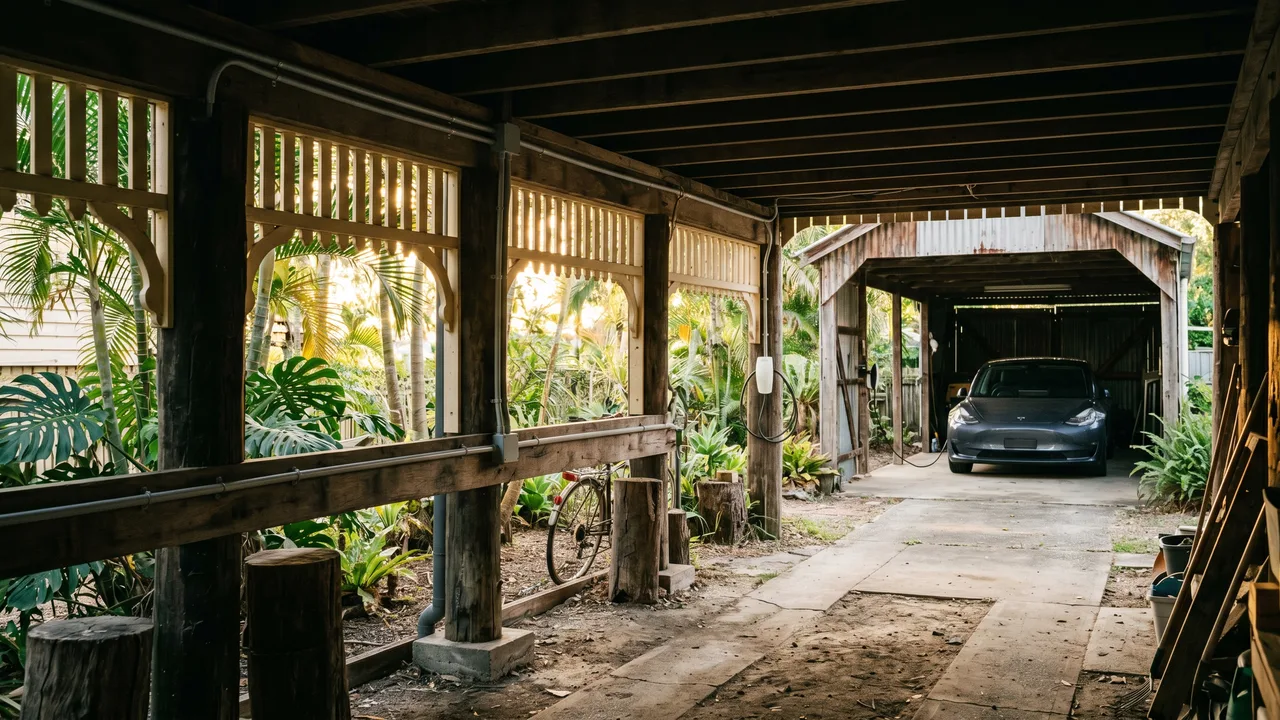
In a Queenslander, the switchboard is typically inside the house and the carport is out the back, down a set of stairs, and under the building. The cable run goes through the subfloor space, along the stumps, out through the skirting, and then either surface-mounted or buried to reach the charge point. That's a longer run (sometimes 20 to 35 metres) and it involves working in a subfloor that can be tight, cobwebbed, and occasionally home to things you'd rather not disturb.
Longer cable runs matter electrically too. Voltage drop across a long run of cable is a real engineering consideration. On a 7.2kW circuit, running undersized cable to cut costs can mean the charger underperforms or the protection device trips more than it should. The cable size needs to be calculated properly, not guessed.
If your Queenslander is in Teneriffe or New Farm, there's a fair chance the subfloor has been partially enclosed as part of a lower-level renovation. That can make the cable run easier (internal walls to chase) or harder (concrete slab areas blocking access), depending on what's been done.
Single-Phase vs Three-Phase: Do You Need to Upgrade Your Supply?
Most older Queenslanders in the inner suburbs are on a single-phase Energex supply. A single-phase Level 2 charger (the wall-mounted units that are standard for home installation) will typically deliver 7.2kW, which charges most EVs at roughly 40 to 50 kilometres of range per hour. For most people, that's more than enough overnight.
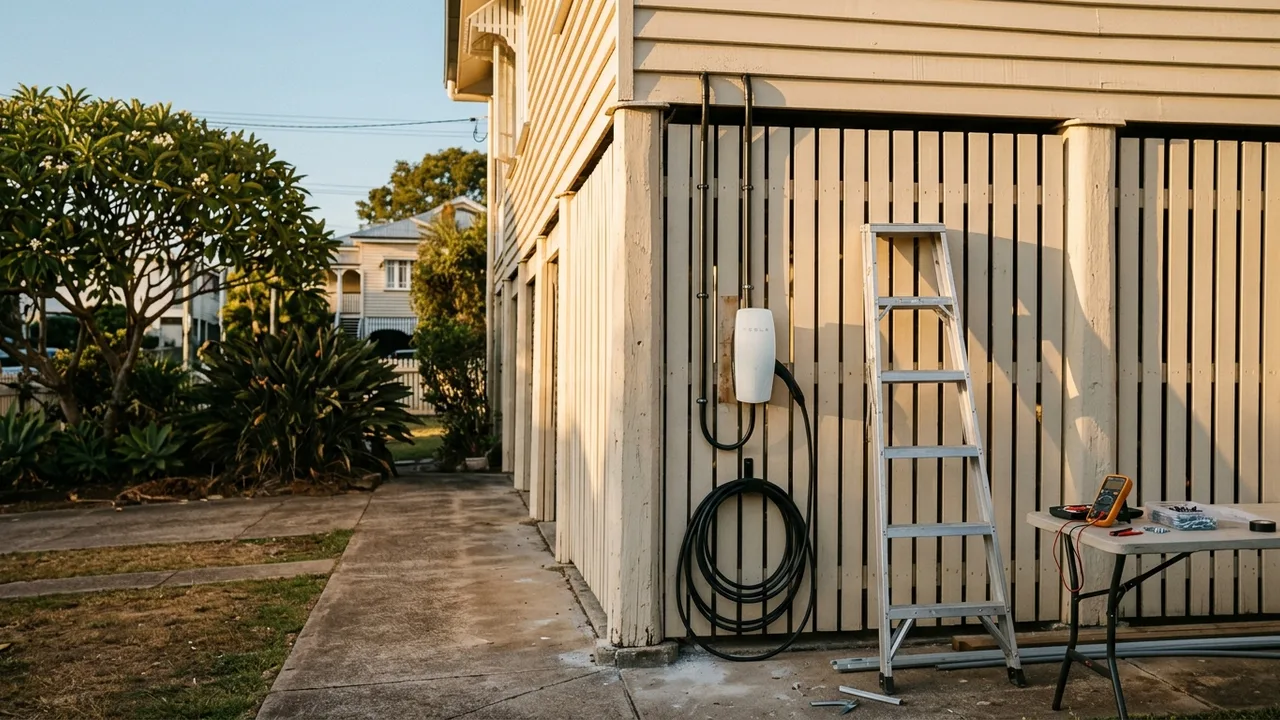
Three-phase supply is more common in newer or recently renovated homes and in some parts of Bowen Hills and Newstead where underground services have been upgraded. Three-phase opens up faster charging speeds (up to 22kW for compatible vehicles and chargers), but it also means a larger service upgrade if your home doesn't already have it. Energex applications for a three-phase upgrade take time and carry a cost that varies quite a bit depending on distance from the street.
For most Queenslander owners, the honest answer is: a well-installed single-phase 7.2kW charger is sufficient. Don't pay for a three-phase upgrade you don't need just because it sounds better.
Solar Integration in an Older Home
If you've already got rooftop solar on your Queenslander, integrating the EV charger with that system is worth thinking about carefully. The concept is straightforward: charge the car during the day using solar generation rather than grid power, and you're essentially running on sunshine.
The practical side is a bit more nuanced. Most older solar inverters (anything more than 5 or 6 years old) don't have the communication protocols to talk directly to a smart EV charger. You can still benefit from solar by simply scheduling charging during daylight hours, but true dynamic load management (where the charger automatically ramps up when solar generation is high) usually requires a smarter inverter or an intermediary energy management device.
If your system is newer and your inverter supports it, the integration is genuinely worthwhile. We wire the charger circuit so it can receive signals from the solar system, and the charger modulates its draw accordingly. Over a year, that kind of setup can noticeably reduce what you're pulling from the grid.
Older Queenslanders in Herston and Wilston with north-facing roofs often have good solar yield, which makes this integration worthwhile even if it requires a small additional outlay.
What a Realistic Budget Looks Like
There's no honest way to give a single number without knowing your specific home, but a realistic range helps set expectations.
A straightforward installation in a Queenslander where the switchboard is modern and the cable run is manageable might land around $1,800 to $2,400 fully installed and certified, including the charger unit.
If the switchboard needs upgrading first, add $1,200 to $2,000 to that.
If the cable run is long or difficult (enclosed subfloor, conduit through concrete, exterior trenching), add $400 to $800.
If you want solar integration with a compatible system, that's typically a modest add-on, around $300 to $600 depending on complexity.
The top of that range, around $4,000 to $4,500, generally reflects a job that needs a full switchboard upgrade, a difficult cable run, and solar integration all at once. That's a complete electrical overhaul for EV charging, and in an older Queenslander, it's sometimes the only safe way to do it properly.
The Practical Steps Before You Call Anyone
Before you get a quote, it helps to know a few things about your own home:
- When was the switchboard last upgraded? If you can see ceramic fuses, assume it needs replacing.
- How far is the proposed charger location from the switchboard? Walk it and estimate roughly.
- Do you have existing rooftop solar? If so, note the inverter brand and model.
- Is your carport enclosed, open, or in a subfloor space? This affects weatherproofing requirements.
- Do you have off-street parking under the house, or in a separate structure? A detached garage or carport involves different considerations than a covered space directly beneath the building.
None of this requires an electrician to figure out. Having these answers ready makes any site visit shorter and your quote more accurate.
A Closing Thought
Queenslanders are worth the extra effort. They're well-built, they sit well on their blocks, and most of them have enough roof space and subfloor access to make a good EV installation genuinely workable. The job just needs someone who understands that older homes have older infrastructure, and that cutting corners on a switchboard or a cable run to get the price down isn't a saving.
If you're in Newstead, Wilston, Windsor, Albion, New Farm, or any of the surrounding inner suburbs and you're thinking about EV charging, it's worth getting a quote from someone who's actually been under a few Queenslander subfloors. The questions you ask before the job starts are the ones that save you money and surprises later.
We're happy to talk through your setup before anything is committed. A 10-minute conversation about your home often tells us most of what we need to give you a realistic figure.
Quick answers