EV Charger Installation guide
Are There Council or Body Corporate Rules Affecting EV Charger Installs in Inner North Brisbane?
Are There Council or Body Corporate Rules Affecting EV Charger Installs in Inner North Brisbane?
Yes, there are, and they vary depending on whether you own a house, a townhouse, or an apartment. For most freehold homeowners in suburbs like Wilston, Windsor, or Albion, council rules are minimal. For those in a strata-titled building in Newstead, Teneriffe, or New Farm, body corporate approval can add real complexity to your install timeline.
Here is what you actually need to know before you start.
Council Rules: What Brisbane City Council Requires
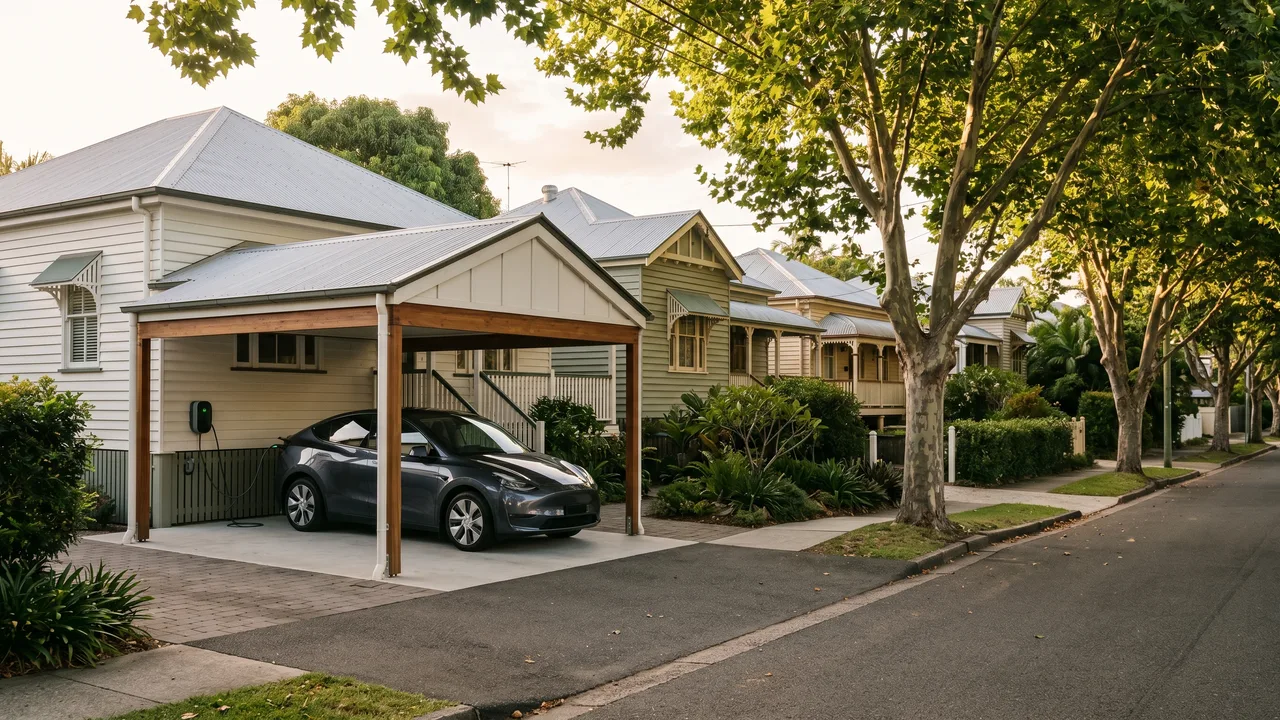
Brisbane City Council does not require a development application (DA) for a standard home EV charger installation. Fitting a wall-mounted charger in a garage or carport is treated as domestic electrical work, not a building alteration. That means no council permit, no site plan submission, no neighbour notification.
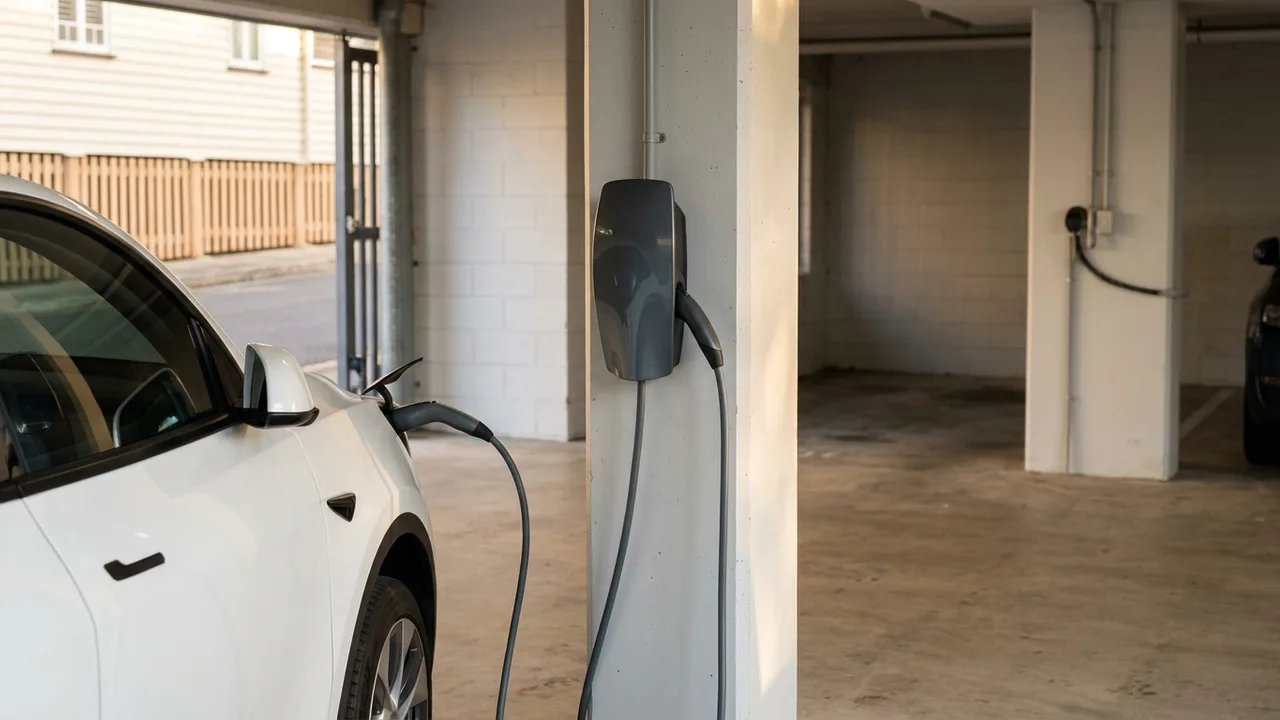
What the council does require is that the work is done by a licensed electrician who lodges a Certificate of Compliance (sometimes called a Form 4) with Energex after the job is finished. This is non-negotiable. An uncertified installation is not just illegal; it can void your home insurance and create liability if there is ever a fault.
A couple of edge cases are worth knowing about:
- If you are in a flood overlay zone (parts of Windsor and Bowen Hills sit in flood-affected areas), there may be requirements around the height of fixed electrical equipment. Your electrician should check this before installing at low level near a garage slab.
- If your home is on the Local Heritage Register or sits within a character overlay, any external changes to the building fabric, like conduit runs on a front facade, might need a closer look. Most Queenslanders in Wilston and Windsor are character homes, but a wall charger inside a garage typically does not trigger heritage issues.
For the overwhelming majority of freehold installs we see across Inner North Brisbane, council rules are not the obstacle. The electrical compliance process is straightforward, and we handle the Energex lodgement as part of every job.
Body Corporate Rules: The More Complicated Conversation
If you live in a strata-titled apartment or townhouse complex, you are dealing with a different set of rules entirely. Body corporates in Queensland are governed by the Body Corporate and Community Management Act 1997 (BCCM Act), and how that Act applies to EV charger installs depends heavily on your building's by-laws and what kind of lot you own.
The core issue is this: an EV charger requires a dedicated electrical circuit. That circuit will almost certainly run through, or be connected to, common property infrastructure in some way, whether it is the main switchboard, a shared cable riser, or a common carpark. Altering or connecting to common property without body corporate approval is not allowed.
What you typically need to do:
- Identify whether your car space is part of your lot (exclusive use area) or common property.
- Check your scheme's by-laws for any existing provisions about EV chargers. Some newer buildings in Newstead and Teneriffe already have by-laws drafted for this.
- Submit a motion to the committee or general meeting. A minor alteration to common property typically requires ordinary resolution (majority vote). Significant alterations may require special resolution (75% agreement).
- Get the approval in writing before any work starts.
The timeline for this can be anywhere from a few weeks (if your body corporate meets regularly and the committee is receptive) to several months (if you need to wait for an AGM or navigate a reluctant committee). Budget for this waiting period. It is frustrating but it is the process.
One practical note: Queensland passed reforms under the BCCM Act that made it harder for body corporates to unreasonably refuse EV charger requests, particularly where the cost falls entirely on the lot owner. If you face pushback, it is worth getting specific legal advice from a strata lawyer before assuming the answer is no.
Older Switchboards and the Inner North Context
This section matters most for houses. A significant number of homes in Windsor, Wilston, and Albion were built between the 1920s and 1970s. Many still have older switchboards with ceramic fuses or early circuit breakers rated for a simpler electrical load.
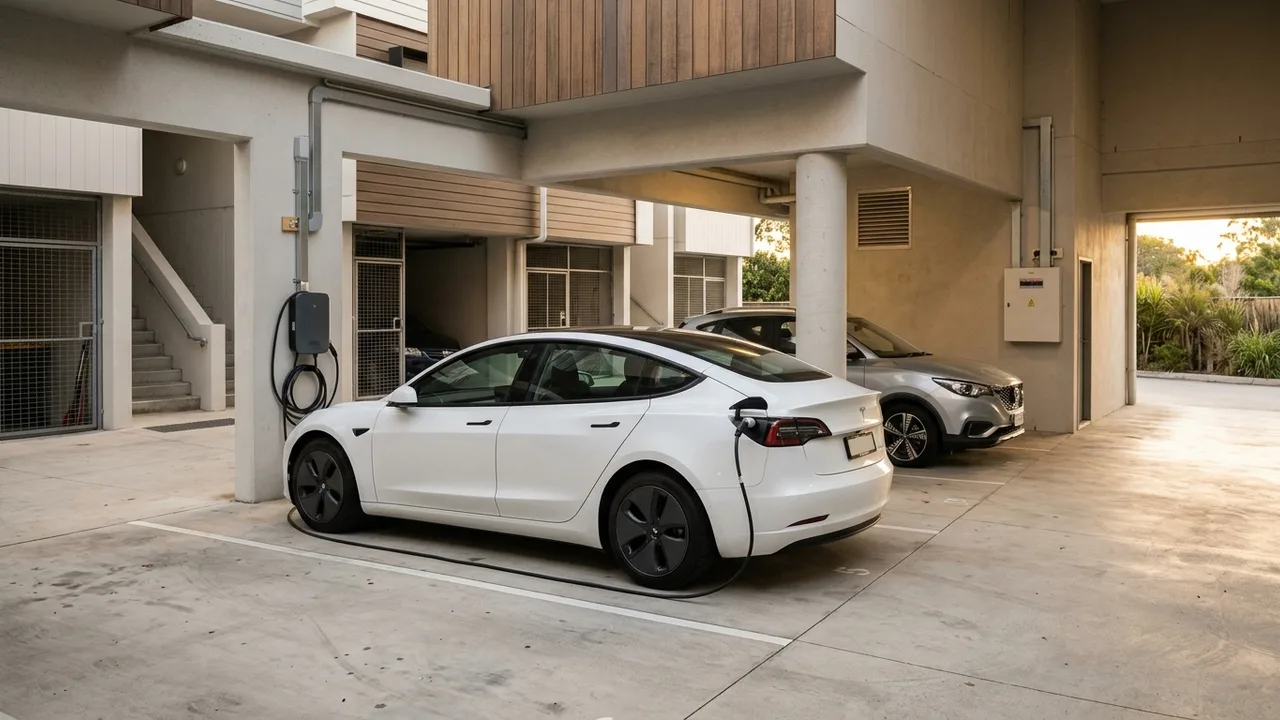
A 7.2 kW Level 2 charger draws around 32 amps continuously. An old switchboard may not have the spare capacity or the right protection devices to support that safely. Before any charger goes in, a licensed electrician needs to assess whether your board can handle the additional circuit.
If it cannot, you are looking at a switchboard upgrade before the charger install. That adds cost, typically $800 to $1,500 on top of the charger installation, but it is not optional. Skipping it creates a fire risk. The upside is that an upgraded switchboard also supports other loads you may add later: induction cooktops, heat pump hot water systems, battery storage.
We assess the switchboard as part of our site inspection on every quote, so there are no surprises on the day of install.
Apartments: Practical Options and Honest Trade-offs
If you are in a high-rise apartment in Newstead or Bowen Hills with a basement carpark, the situation is more nuanced. Here are the realistic options:
Dedicated circuit from your lot's meter: The cleanest solution. A circuit runs from your apartment's distribution board down to your car space. This keeps metering simple (you pay for what you use) but may involve significant cable runs and body corporate approval for the path through common property.
Shared infrastructure or sub-metering: Some buildings opt for a shared EV charging system for multiple residents, managed through a sub-metering provider. This avoids individual approval battles but requires a collective decision and significant upfront building works.
Portable or outlet-based charging: A few residents use a 10-amp or 15-amp GPO (general purpose outlet) already installed in the carpark for limited overnight charging. This avoids body corporate approval for new wiring but delivers much slower charge rates (around 2-2.4 kW on a standard 10-amp outlet). It is a workaround, not a long-term solution for most EV drivers.
There is no single answer here. The right approach depends on your building's age, existing electrical infrastructure, and how cooperative the body corporate is. We can assess the technical side; for the approval strategy, a strata lawyer or a body corporate manager experienced in EV matters is worth consulting first.
Solar Integration in Inner North Brisbane: An Extra Layer to Consider
If you already have rooftop solar and want to link it to your EV charger, the rules do not change much. You still need the same approvals. But there is a practical point specific to Inner North Brisbane: many homes here are on smaller inner-city blocks with constrained roof space and older or shaded roofs (especially Queenslanders with hip roofs and mature street trees).
The benefit of solar-integrated charging, drawing on daytime generation to charge for close to zero cost, is real. But it only works well if your system generates a meaningful surplus during the day, and only if your charger supports dynamic load control. A basic wall charger will not do this; you need a smart charger with a CT clamp (current transformer) installed to read your solar export in real time.
Worth knowing: feed-in tariffs in Queensland have dropped significantly in recent years, so using solar to charge your car rather than exporting it is increasingly good value.
What to Do Before Calling an Electrician
Getting your install right from the start saves time and money. Here is a sensible sequence:
- Freehold house: Check your switchboard age, confirm your garage or carport layout, and get a quote that includes compliance certification.
- Townhouse with body corporate: Read your by-laws, check whether your car space is lot or common property, then start the approval process before booking an electrician.
- Apartment: Talk to your body corporate manager first. Understand the approval pathway and likely timeline before you spend anything on electrical assessments.
- Heritage or flood overlay: Mention this to your electrician upfront. Most installs in these areas proceed normally, but it is better to know early.
If you are in Newstead, Teneriffe, New Farm, Herston, Wilston, Windsor, Albion, or Bowen Hills and you are not sure which category applies to you, a quick conversation before booking a site inspection can save a lot of back-and-forth. We are familiar with the building types and approval quirks across Inner North Brisbane, and we are happy to talk through your situation before you commit to anything.
Quick answers