EV Charger Installation guide
EV Charger Demand Is Rising Fast Across Brisbane's Inner North
EV Charger Demand Is Rising Fast Across Brisbane's Inner North
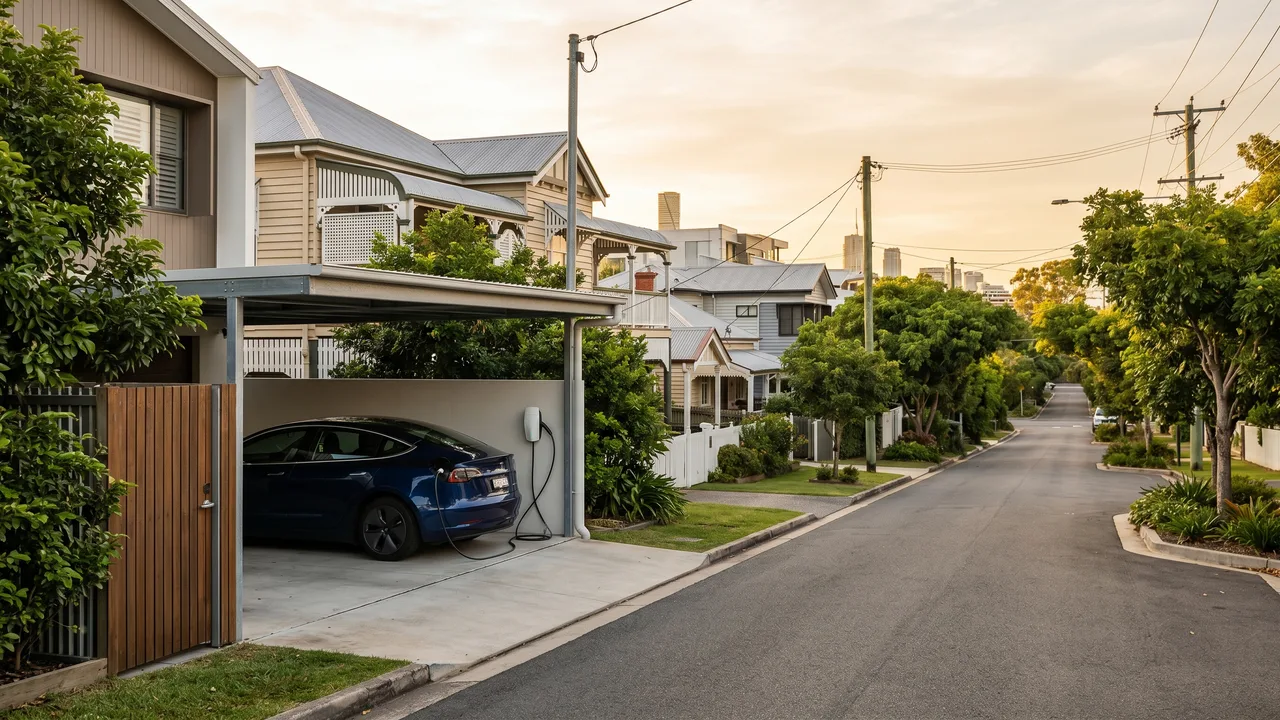
The shift is already happening. Across suburbs like Newstead, Teneriffe, Windsor and Wilston, more households are parking an electric vehicle in the garage or carport and then immediately asking the same question: where do I plug it in properly? Demand for home EV charger installation in Brisbane's inner north has climbed noticeably over the past two years, and it is not slowing down.
This article covers what is driving that demand, what the installation actually involves, where it gets complicated, and how to think through the decision sensibly.
Why the Inner North Is Seeing This Shift First
Brisbane's inner north corridor, running roughly from New Farm and Teneriffe through Newstead, Bowen Hills and up to Albion, Windsor and Wilston, has a few characteristics that make EV adoption land here before it spreads to outer suburbs.
Household income is higher than the Brisbane average, which matters because the upfront cost of an EV is still significant. The housing stock skews toward owner-occupied character homes and newer townhouses, both of which typically have off-street parking. And the demographic here tends toward early adopters: people who have already put solar on the roof and are now asking what comes next.
There is also a practical geography at play. Inner north residents often commute into the CBD, Fortitude Valley or the health precinct around Herston. Those are short distances. A Level 2 home charger (an AC wall-mounted unit running on a dedicated 32-amp circuit, as opposed to a slow 10-amp trickle charge from a general power outlet) can add roughly 25-50 km of range per hour depending on the vehicle. For a typical inner-city commute of 15-20 km each way, you can top up overnight without thinking about it.
What a Proper Home Installation Actually Involves
Plugging your EV into a standard 10-amp powerpoint is possible, but it is slow and not designed for continuous overnight loads. Most automakers and electricians advise against it as a permanent solution. A dedicated Level 2 wall charger is the right setup for home use.
Here is what the installation typically covers:
- A dedicated circuit run from your switchboard to the charger location, usually in a garage or undercover carport.
- A wall-mounted charging unit (sometimes called an EVSE, or Electric Vehicle Supply Equipment) rated at 7 kW for single-phase or up to 22 kW for three-phase, though most Brisbane homes are single-phase.
- A licensed electrician completing the work and issuing a Certificate of Compliance for Electrical Work (CCEW) under Queensland rules.
- A switchboard assessment, because older boards in character homes across Windsor, Wilston and parts of Albion often need work before they can safely carry the extra load.
Total cost for a straightforward single-phase installation typically sits between $1,800 and $2,800. If the switchboard needs upgrading, or the cable run is long, or your home has an older wiring system, budget toward $3,500 to $4,500.
The Switchboard Problem in Older Inner North Homes
This is the part many people do not anticipate. A significant share of the housing stock across Windsor, Wilston and parts of Albion dates from the 1950s to 1980s. These homes often still have older switchboards with ceramic fuses rather than circuit breakers, or boards that are simply full with no spare capacity for a new dedicated circuit.
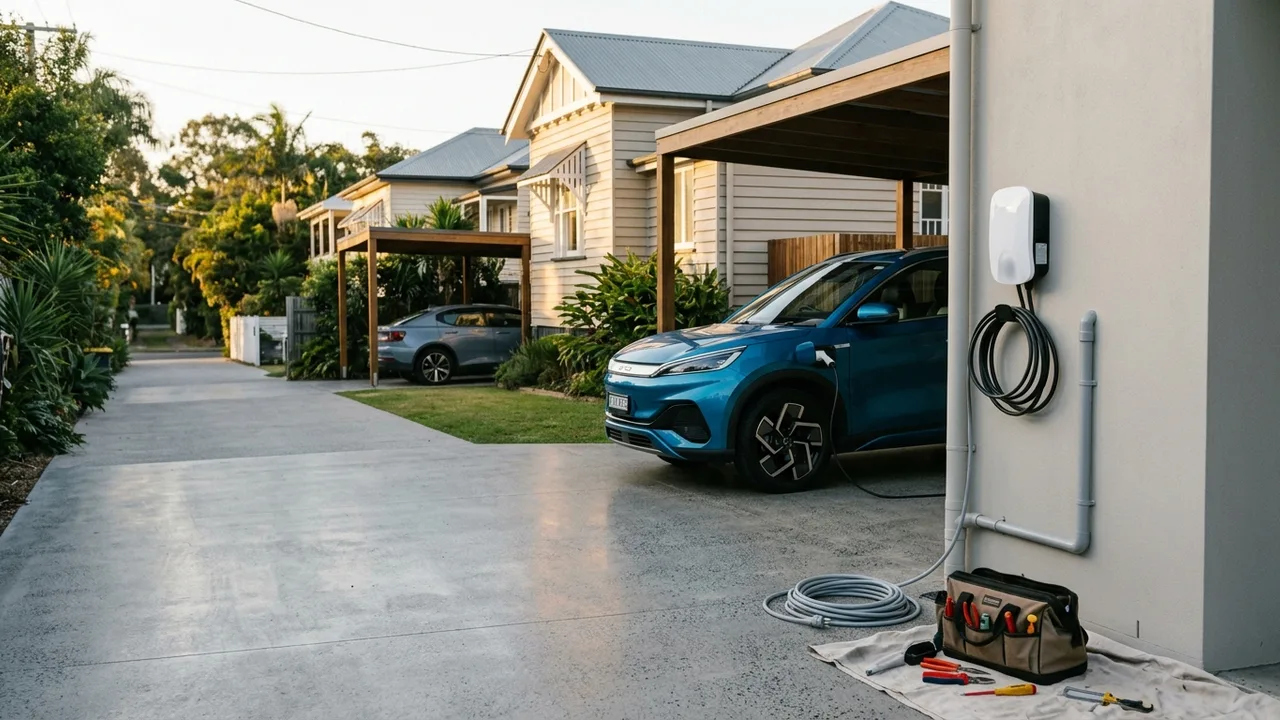
Adding a 32-amp EV circuit to a board that is already running a ducted air conditioner, an electric hot water system and an induction cooktop is not always straightforward. A licensed electrician needs to assess the available load capacity before sizing the EV circuit correctly.
A switchboard upgrade typically adds $800 to $1,800 to the job depending on the board type and whether the metering needs to be reconfigured. It is not a cost anyone enjoys, but it is the kind of work that pays off. A compliant, correctly sized switchboard also makes your home easier to insure and easier to sell.
Apartments and Strata: A Different Problem Entirely
For residents in the apartment and townhouse complexes that have appeared across Newstead, Bowen Hills and Teneriffe over the past decade, the challenge is less about wiring and more about governance.
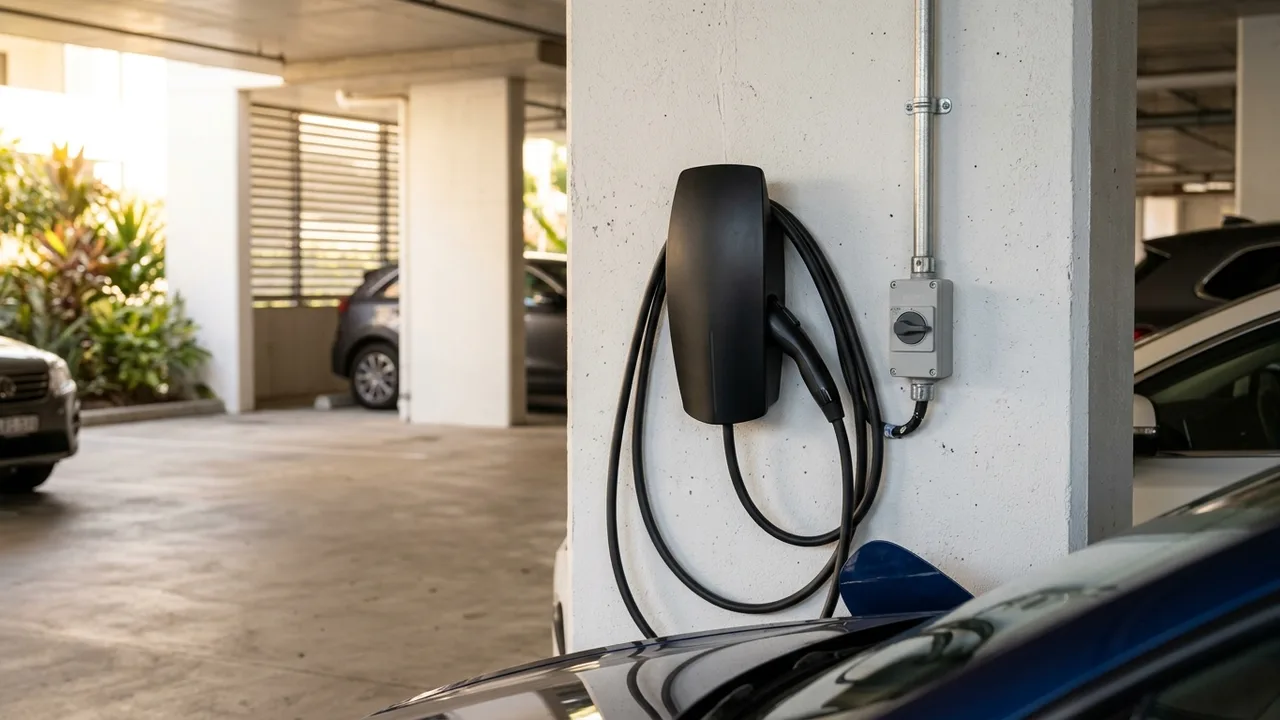
Installing an EV charger in a strata basement requires body corporate approval. The process varies by scheme, but generally involves submitting a proposal that covers the proposed charger location, how the electricity will be metered (so only you pay for what you use), and confirmation that the installation will not compromise the building's common electrical infrastructure.
This is not impossible, and many bodies corporate in inner Brisbane are now actively accommodating EV charging requests because they know more residents will ask soon. The key is submitting a well-documented proposal with a qualified electrician's assessment attached. We have worked through this process with residents in several inner north buildings, and the approval step typically takes two to six weeks depending on when the committee next meets.
The installation itself, once approved, involves running a dedicated sub-metered circuit from the building's distribution board to your allocated car space. Costs vary more widely here, starting around $2,500 and potentially reaching $4,500 or more depending on cable run distances in the basement.
Solar Integration: Does It Actually Make Sense?
If you already have rooftop solar, the obvious question is whether you can use it to charge your EV. The honest answer is: yes, but with caveats.
Most EV charging happens overnight, when solar panels produce nothing. So a direct solar-to-EV workflow requires either a home battery (expensive) or a solar diversion device that pushes surplus daytime generation to the charger instead of exporting it to the grid.
Solar diversion is genuinely useful if someone is home during the day and the car is plugged in. It works well for shift workers, those working from home, or households with a second vehicle that is not used daily. For a standard household where both cars leave at 7 am and return at 6 pm, the benefit is more limited.
The integration itself is not complicated. It involves a smart charger with load management capability connected to a current transformer (CT) sensor on your solar inverter or switchboard. The charger then ramps up or down based on available solar surplus. We wire this during the initial installation rather than retrofitting later, because the labour cost difference is minimal and the result is cleaner.
How to Think Through the Decision
If you are considering a home EV charger installation in the inner north, here is a straightforward way to approach it.
First, check your switchboard. If it still has ceramic fuses, budget for an upgrade and factor that into your overall cost. It will need doing regardless.
Second, check your parking situation honestly. A covered, off-street space with reasonable proximity to the switchboard keeps installation costs down. A carport at the far end of a long block away from the house is not a dealbreaker, but it adds cable and labour.
Third, think about your daily driving. If you are covering 40 km a day or less, a standard 7 kW single-phase charger on a dedicated circuit is almost certainly enough. You do not need three-phase unless your vehicle supports it and your driving patterns genuinely justify it.
Fourth, get a quote that includes a switchboard assessment, not just a charger price. Any electrician quoting EV work in an older inner north home should be walking through this with you, not leaving it as a surprise line item later.
If you are in Newstead, Teneriffe, Windsor, Wilston, Albion, New Farm, Bowen Hills or Herston and want to talk through your specific setup before committing, we are happy to run through the basics over the phone with no pressure to book. Sometimes that conversation saves you time and money before anyone picks up a tool.
Quick answers