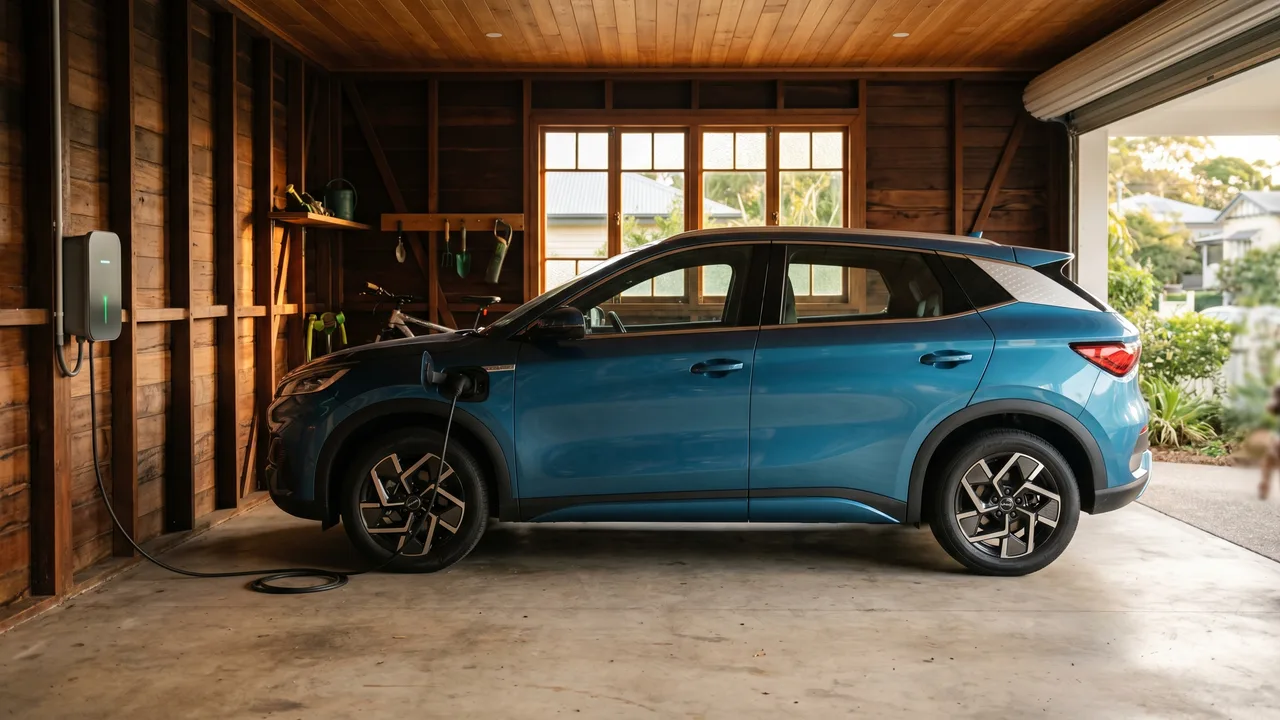
EV Charger Installation guide
Is a Dedicated Level 2 Charger Worth It Over a Standard Powerpoint?
For Most EV Owners, Yes — With One Important Caveat
A dedicated Level 2 charger is worth it for the majority of EV owners who drive more than 30 km a day or charge at home regularly. The caveat: if you genuinely only top up once or twice a week and your battery is rarely below 80%, a standard 10-amp powerpoint might be all you need for now.
That said, most people who ask this question have already noticed the frustration. You plug in overnight, wake up, and the car has only recovered 30–40 km of range. For a lot of drivers in Newstead, New Farm or Wilston who are commuting, running errands and using the car as a genuine daily driver, that slow trickle simply does not keep up.
Here is a closer look at the real differences, the costs, and how to decide.
What "Level 2" Actually Means
The term can sound more technical than it is. In Australia, home EV charging broadly splits into two tiers.
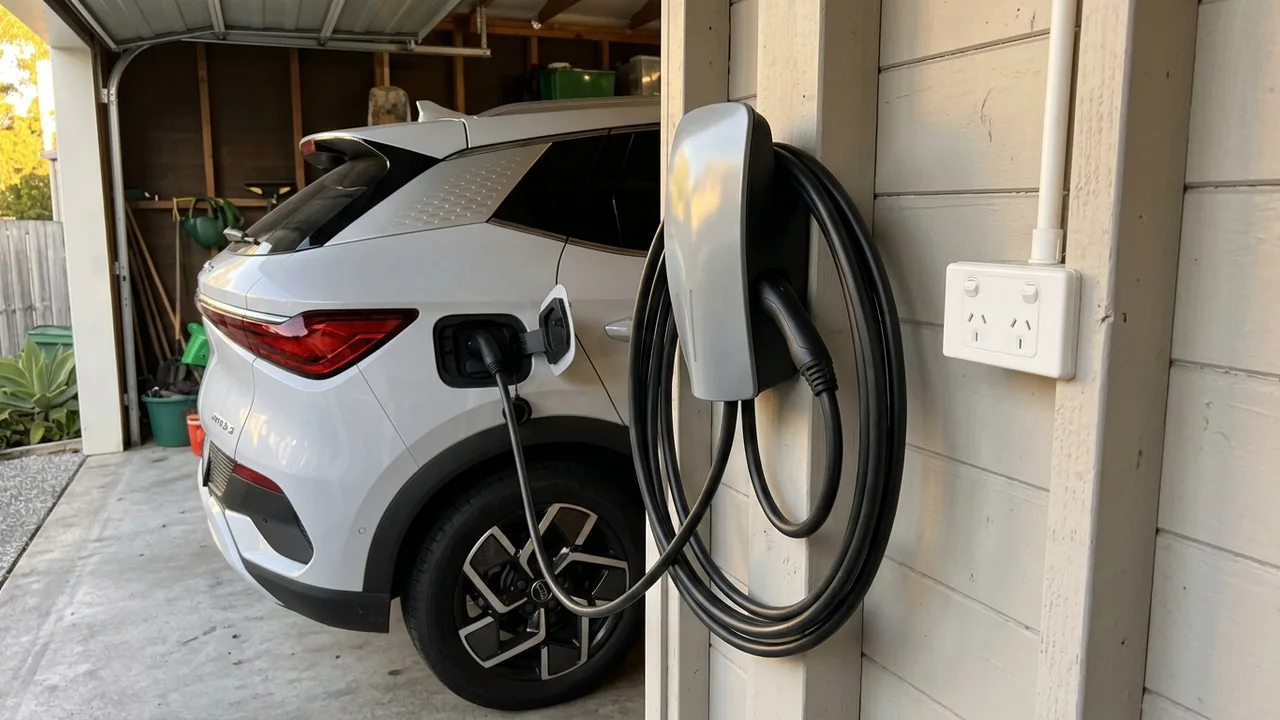
Level 1 is your standard household powerpoint: 10 amps, 230 volts, roughly 2.2–2.4 kW of power. It adds somewhere between 10 and 15 km of range per hour, depending on your vehicle. Leave it plugged in for 8 hours and you have recovered maybe 100–120 km. That is fine if you drive a short loop and your car sits idle for long stretches.
Level 2 is a dedicated single-phase or three-phase circuit feeding a wall-mounted charging unit (sometimes called an EVSE, or Electric Vehicle Supply Equipment). A typical single-phase Level 2 setup runs at 7.2 kW and delivers around 40–50 km of range per hour. A three-phase unit can push 11–22 kW, adding 60–100 km per hour or more, though your car's onboard charger needs to support those speeds to take advantage of them.
The practical upshot: a Level 2 charger can fully recharge most family EVs overnight from near-empty. A standard powerpoint often cannot.
The Real Cost Comparison
The powerpoint itself costs you nothing extra to install if one is already in your garage or carport. The hardware cost is zero. But the hidden costs are in the limitation.
A dedicated Level 2 installation in Brisbane typically runs between $1,800 and $4,500 all in, depending on the charger model, the distance from your switchboard, whether your switchboard needs an upgrade, and whether a trenching run is required. In older Inner North Brisbane homes, particularly Queenslander-style houses in Wilston, Windsor or Albion with original switchboards, a switchboard upgrade is often needed before a dedicated circuit can be added safely. That adds to the job but also brings your electrical system up to current standards, which has broader safety benefits.
Smart chargers (units with app control, load balancing and scheduled charging) sit at the higher end of that range. A basic hardwired unit with no scheduling features sits closer to the bottom. If you have rooftop solar, a smart charger that can communicate with your inverter and shift charging to solar hours is worth the extra spend, typically $200–$600 more on the hardware.
The trade-off is straightforward: you pay once, then benefit every day. If you charge at home 200 nights a year and your Level 2 charger saves you 30 minutes of range anxiety each morning, that adds up quickly in both convenience and, where solar is involved, in dollars.
Why the Powerpoint Option Has a Hidden Risk
Beyond the slow charge speed, running an EV from a standard 10-amp powerpoint long-term carries some genuine risks worth knowing about.
Standard powerpoint circuits are not designed for sustained high-load use over many hours. An EV charger running through a powerpoint draws close to the full 10-amp rating, continuously, for 6–10 hours. That is different from a kettle boiling for 3 minutes. Over time, loose connections, older wiring or an underrated socket can overheat. It is not a common failure, but it does happen, and older homes in suburbs like Herston, Bowen Hills and Windsor are more likely to have the kind of ageing circuits where this is a real consideration.
A dedicated Level 2 circuit uses a cable rated for continuous high-load use, a separate breaker on the switchboard, and a charger unit with built-in safety electronics. It is simply a cleaner, safer setup.
Apartments and Townhouses: A Different Conversation
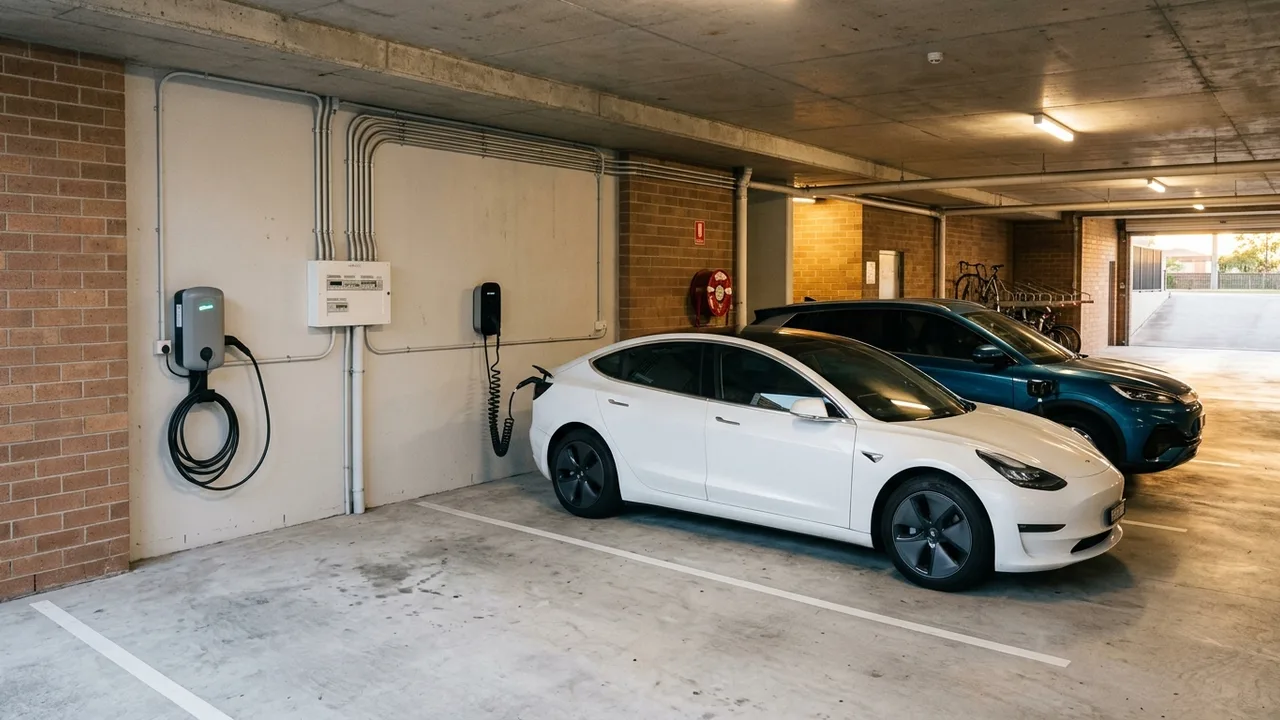
If you are in a strata apartment or townhouse in Teneriffe, Newstead or New Farm, the calculation gets more complicated. You likely do not have direct access to a dedicated circuit, and any electrical work in common areas requires body corporate approval.
The good news is that dedicated EV charger solutions for apartments are now more practical than they were a few years ago. Load-managed systems can share a single circuit across multiple residents without tripping switchboard limits. If you are the first in your building to push this, it is worth having a licensed electrician prepare a technical brief for the body corporate committee. We handle that documentation as part of our apartment installation work in Inner North Brisbane.
The powerpoint workaround is even less suitable in apartments, because your garage powerpoint is typically on a shared circuit with strict amperage limits. Sustained EV charging on those circuits is exactly the kind of thing strata managers push back on.
Solar Integration Changes the Economics
If your roof already has a photovoltaic (PV) solar system, a smart Level 2 charger is not just a convenience upgrade. It can meaningfully shift how much you export to the grid versus how much you self-consume.
Brisbane's grid feed-in tariffs have dropped considerably over the years. In most cases, you earn less per kilowatt-hour selling excess solar than you pay to buy it back at night. A smart charger lets you schedule charging to peak solar hours (roughly 10am to 3pm), so you are effectively fuelling the car for close to nothing. Depending on your commute, this can save $500–$1,500 per year compared with charging from the grid at night.
That equation makes the upfront cost of a dedicated Level 2 smart charger look much better. In some setups, the charger pays for itself within two to four years purely through avoided electricity costs.
Our Honest Recommendation
If you drive your EV daily and you have a garage or covered carport with reasonable switchboard access, a dedicated Level 2 charger is worth the investment. The convenience alone justifies it for most households, and the safety and solar arguments reinforce that conclusion.
If you drive fewer than 20 km most days, have a plug-in hybrid with a small battery, and your garage already has a powerpoint right there, the urgency is lower. You might hold off until you change vehicles or your circumstances shift.
What we would not recommend is running a long-term EV daily driver on a standard powerpoint indefinitely. It is not the end of the world, but it is a compromise that compounds over time.
If you are in Newstead, New Farm, Wilston, Teneriffe, Windsor, Albion, Herston or Bowen Hills and you want a plain-spoken quote without the runaround, we are happy to assess your setup and give you an honest recommendation on what you actually need, not the most expensive option on the shelf. Give us a call or send a message with your suburb and vehicle model.
Quick answers