EV Charger Installation guide
EV Charger Installation in Newstead: What Local Properties Actually Require
What Newstead Properties Actually Need for EV Charger Installation
Most homes in Newstead and the surrounding inner north can support a Level 2 home charger, but the exact requirements depend on three things: your switchboard, your parking setup, and whether you're in a strata-titled property or a freestanding house. Get those three right, and the rest of the installation is usually straightforward.
The Lay of the Land: What Makes Inner North Brisbane Different
Newstead, Teneriffe, Bowen Hills and New Farm are not your typical suburban sprawl. The housing stock here is a mix of converted warehouses, newer high-density apartments, post-war workers' cottages, and 1990s-era townhouse complexes. Each type comes with its own electrical history.
The converted warehouses and boutique apartment blocks along the river in Teneriffe and Newstead often have older three-phase switchboards originally sized for commercial loads. That sounds promising, but in practice the individual tenancy boards inside these buildings are sometimes surprisingly undersized. Newer complexes built after about 2010 tend to have more headroom.
In Windsor, Wilston and Albion you're more likely to encounter a freestanding home with a single-phase 63-amp board, often installed when the house was last rewired in the 1990s or early 2000s. These boards can usually support a 7.2 kW charger, but they need proper assessment before anyone connects anything.
Herston sits close to the PA Hospital precinct, so there's a reasonable number of rental properties managed by investors rather than owner-occupiers. If you rent here, charger installation still has options, but you'll need written landlord consent and should check whether the building's common meter arrangement complicates private sub-metering.
Switchboard First: Why This Step Gets Skipped and Shouldn't Be
A dedicated Level 2 charger (also called a home AC charger) typically draws between 7.2 kW and 22 kW, depending on the unit. For most houses in this cluster, a 7.2 kW single-phase unit is the practical choice. It adds roughly 40-50 km of range per hour of charge, which is plenty for overnight use.
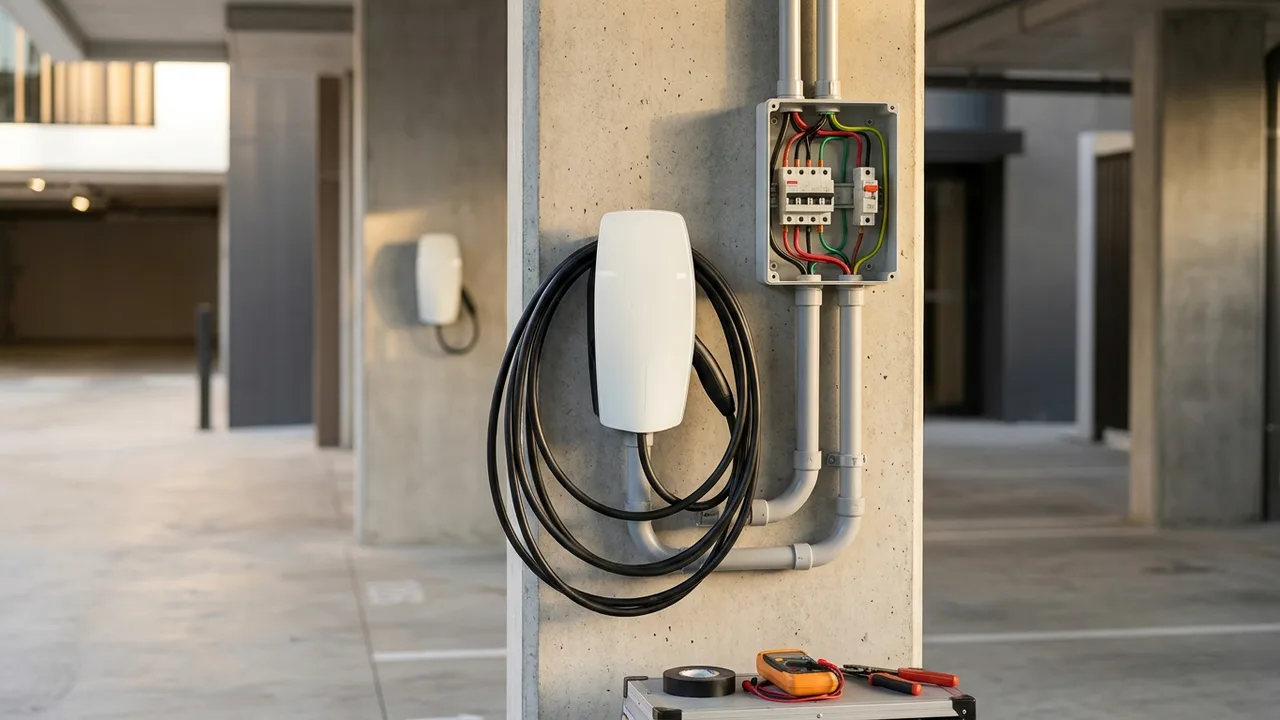
To run that safely, you need a spare circuit breaker slot, an RCD (residual current device) protecting the circuit, and enough spare capacity on your main board that you're not constantly tripping other circuits when the dishwasher runs at the same time as the car.
Older single-phase boards with ceramic fuses, or boards that are already full, need upgrading before a charger goes in. A switchboard upgrade in a typical Brisbane inner-north home typically runs $900 to $1,800 depending on the board's age, whether the meter box needs reconfiguring, and the cable run involved. That's separate from the charger itself.
We assess the switchboard as the first step on any quote, because skipping it and discovering the problem on installation day wastes everyone's time.
Parking Setup: Garage, Carport, or Street?
Where your car parks matters almost as much as the switchboard. The cable run from your board to the charger is one of the bigger variables in the final cost.
In a single garage attached to the house, the run is often short, 5-10 metres, and the installation is clean and straightforward. These jobs typically sit toward the lower end of our $1,800-$4,500 range.
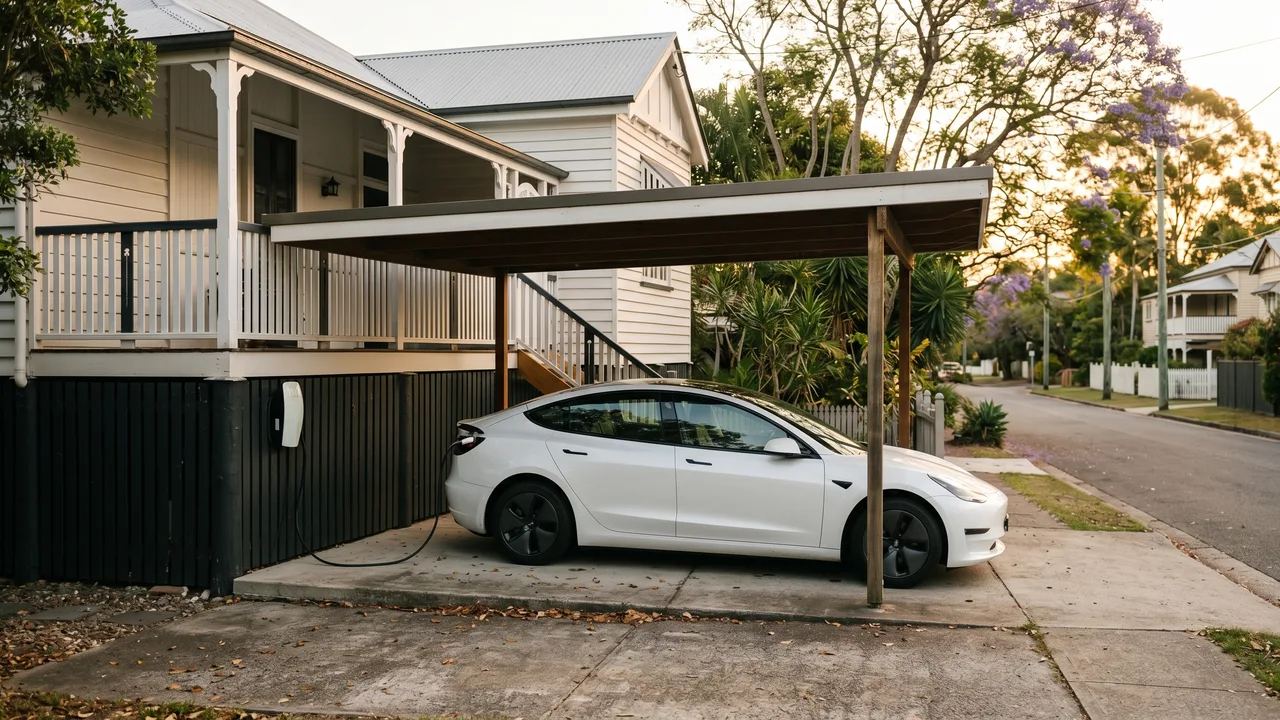
Detached garages or carports at the back of the block, common in Windsor and Albion on standard 405-square-metre lots, mean a longer cable run, sometimes underground conduit under a driveway, and occasionally a sub-board at the carport. Budget more for these, and expect a bit more disruption to the garden or driveway surface.
Basement car parks in apartment buildings are a different matter again, covered in the next section.
On-street parking is, unfortunately, not a viable option for a home charger. There's no safe or legal way to run a cable from your unit to a kerb-side car spot. If you park on the street and have no off-street parking, a portable EVSE (electric vehicle supply equipment) plugged into a regular power point is the fallback, but it's slow and not designed for every-night use.
Apartments and Strata: The More Complex Conversation
This is where things genuinely get more involved, and we'd rather be honest about that upfront than gloss over it.
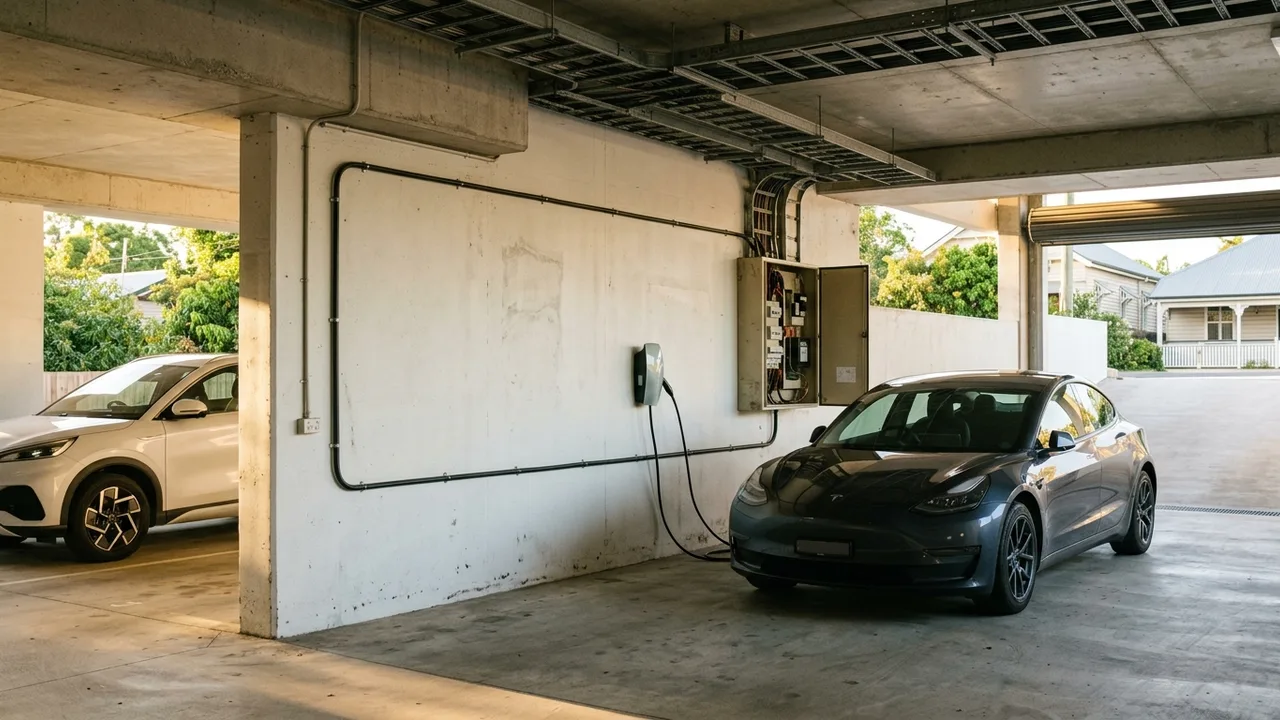
If you own or rent in a strata-titled apartment or townhouse complex in Teneriffe, Bowen Hills or New Farm, you almost certainly need the body corporate's approval before any electrical work touches common property. In Queensland, a body corporate cannot unreasonably refuse a request for EV charging infrastructure, but "unreasonably" still leaves room for processes, meetings, and delays.
Practically, the path forward depends on whether:
- Your car space has its own sub-meter (or can get one) so costs can be attributed to your lot
- The basement distribution board has spare capacity
- The body corporate is open to a "user pays" model for the circuit
We've worked through all three scenarios across properties in this cluster. The installation itself, once approvals are in place, is not dramatically more complex than a house install. It's the pre-work that takes time. Allow four to eight weeks for the approval process in a well-run strata scheme; longer in others.
Solar Integration: Worth Doing If You Already Have Panels
If you have a rooftop solar photovoltaic (PV) system and you're adding an EV charger, pairing them with a smart charger that communicates with the inverter can meaningfully reduce your ongoing electricity cost.
The principle is simple: a smart charger with load balancing can be set to charge the car primarily when your solar is producing excess energy rather than exporting it to the grid at a low feed-in tariff. In a typical Brisbane installation where panels produce well from about 9am to 3pm, this works best if someone is home during the day, or if the car doesn't need to be ready to leave early every morning.
The trade-off is cost. A basic 7.2 kW wall charger might cost $500-$800 for the hardware. A smart charger with solar integration, app control, and load balancing typically runs $900-$1,500 for the unit alone, before installation. For most households, the payback is real but takes a few years to stack up. It's worth doing if you intend to stay in the property, not necessarily if you're renting or planning to sell soon.
Compliance, Inspection, and the Certificate You Actually Need
In Queensland, EV charger installation must be carried out by a licensed electrician. The work requires a Electrical Safety Certificate of Compliance (also called a Form 4), which your installer lodges with the relevant authority. You should receive a copy.
If you've bought a property where a charger was already installed, or inherited one from a previous tenant, it's worth confirming that a compliance certificate exists for it. A charger wired without proper certification is a problem for insurance purposes and potentially for resale.
We offer a standalone inspection and compliance certificate service for existing chargers in Newstead and across the cluster suburbs, exactly for this situation.
A Straightforward Recommendation
There's no single answer that fits every Newstead property. A freestanding house in Wilston with a modern board and an attached garage is one of the easier installs you'll find. An apartment in a 1980s Teneriffe complex with an unresponsive body corporate is a longer, more complicated job.
What we'd suggest is this: before you buy a charger online and book a sparky to install it, get a proper assessment of your switchboard and parking setup done first. It takes about 30 minutes on site and it prevents expensive surprises. The cost of the charger you've already ordered may not suit your board or your actual power needs, and returning it is usually more hassle than it sounds.
If you're in Newstead, New Farm, Teneriffe, Wilston, Windsor, Albion, Bowen Hills or Herston and you'd like an honest quote that starts with an assessment rather than a catalogue, give us a call or send through your address and we'll tell you what's actually involved.
Quick answers