EV Charger Installation guide
Installing an EV Charger in a Queenslander Home Is Not Always Straightforward
Installing an EV Charger in a Queenslander Home Is Not Always Straightforward
Most Brisbane homeowners assume installing an EV charger is as simple as booking an electrician and picking a spot on the wall. In a modern brick-veneer home with a single-storey layout and a recent switchboard, that is often close to the truth. In a Queenslander, it usually is not.
The raised timber floor, the aged wiring, the detached garage or open carport, the sub-floor cable runs — every one of these is a variable that can shift what should be a half-day job into a multi-day project with a noticeably larger invoice.
This article walks through the specific challenges Queenslander owners face, what they actually cost, and how to think about the trade-offs before you book anyone in.
Why Queenslanders Are a Different Electrical Problem
A typical Queenslander in Wilston, Windsor or New Farm was built anywhere from the 1910s to the early 1960s. The electrical system reflects that era. You will often find:
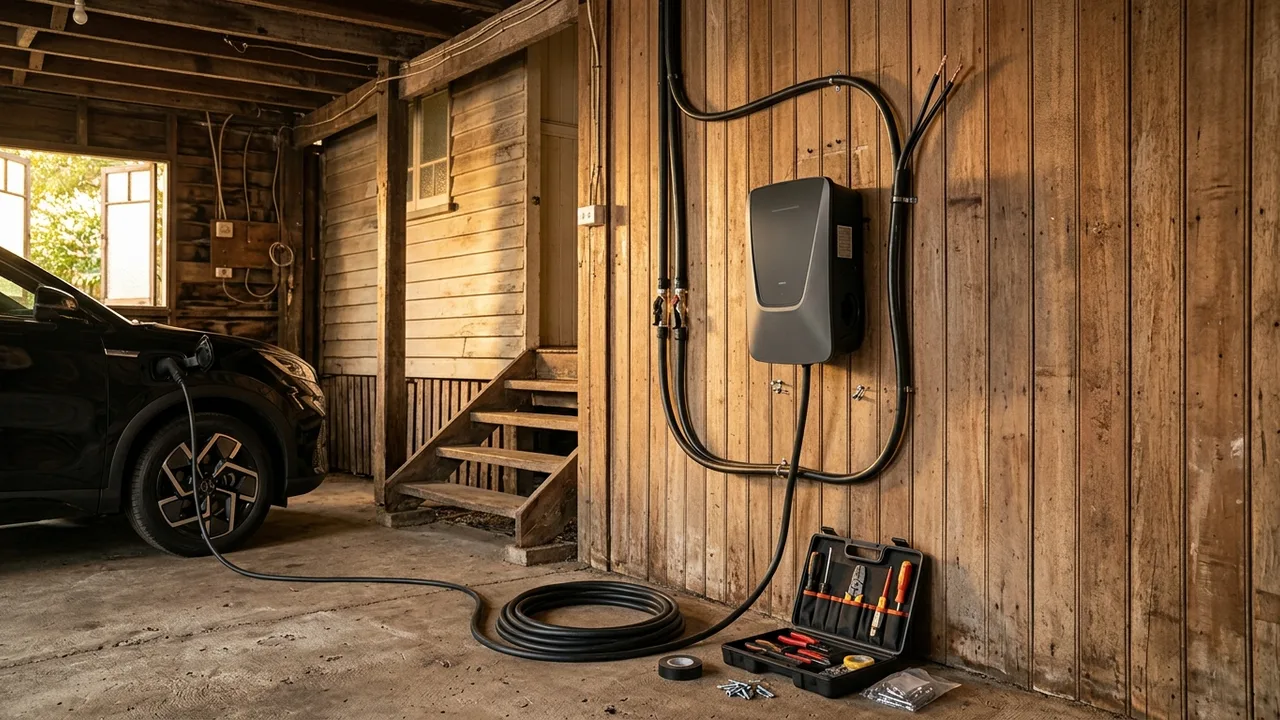
- A ceramic fuse board, or an early circuit-breaker board with no spare capacity
- Wiring in older rubber-insulated or aluminium conductors that may not be safe to extend or load further
- No RCD (residual current device) protection on power circuits
- A single-phase supply that was sized for the loads of fifty or sixty years ago
A Level 2 home EV charger (the dedicated wall unit that charges most cars overnight) draws between 16 and 32 amps on a dedicated circuit. That is a meaningful chunk of your home's total electrical capacity. On an old ceramic fuse board, you cannot simply add a circuit. The board has to go first.
Switchboard upgrades in Brisbane typically run from $1,200 to $2,500 depending on the size and complexity of the job. When you are already budgeting $1,800 to $4,500 for the charger supply and installation, that can double the overall spend for some properties.
The Detached Garage and Carport Problem
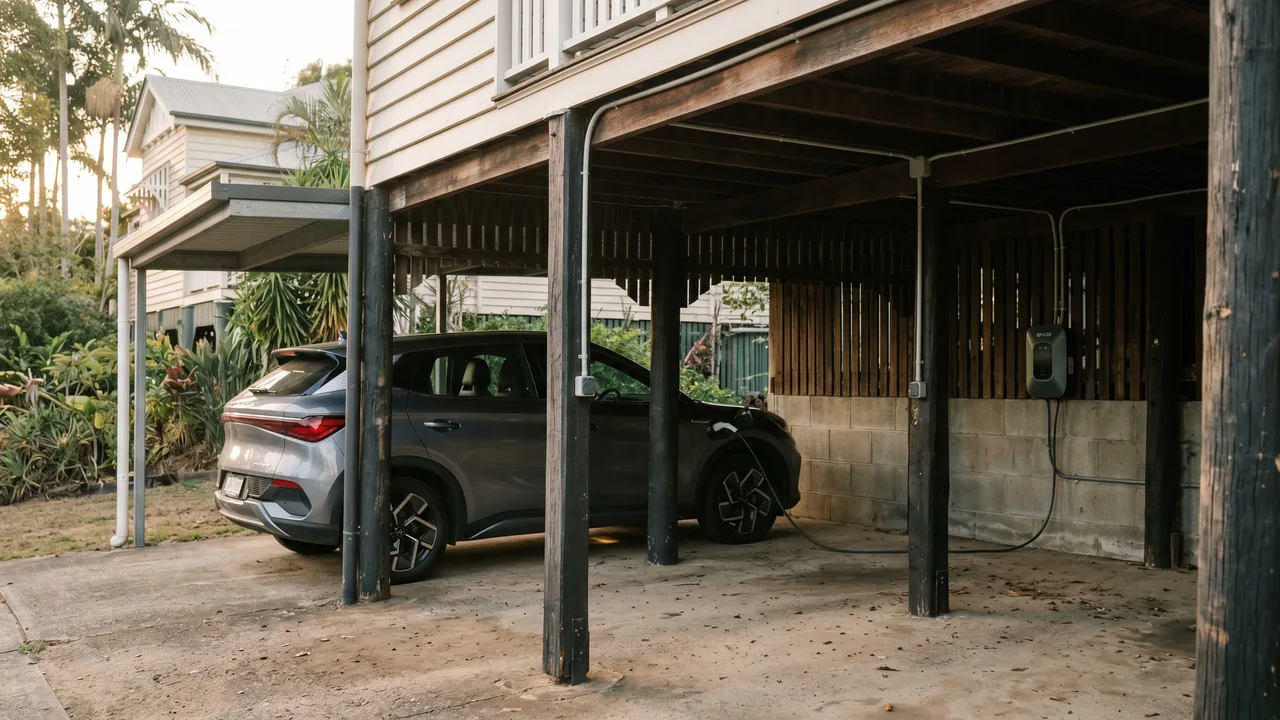
Many Queenslanders have a garage or carport that sits separately from the main house, often at the bottom of the sloped block. Running a dedicated 32-amp circuit from the main switchboard down to that structure is where costs can escalate quickly.
The cable has to travel from inside the house, under the sub-floor, out through the stumps, and across or under the yard to reach the garage. In some cases the garage is on the street level while the house sits up on stumps two to three metres above, which means a long conduit run along the exterior or a trenched underground cable.
Trenching across a 10 to 15-metre yard is typically charged by the metre. As a rule of thumb, allow $80 to $150 per metre for trenching and conduit in Brisbane residential work, though rocky soil or established root systems from old fig or mango trees can push that higher. A 12-metre run under a concrete driveway can add $1,500 to $2,000 on its own.
If your carport is open and exposed to weather, you also need a charger rated for outdoor installation (IP54 or higher), which is standard for quality units but worth confirming before you accept a quote.
Sub-Floor Access: Hidden Complexity
Queenslanders sit on timber stumps, and that sub-floor space looks like it should make cable runs simple. Sometimes it does. Sometimes it does not.
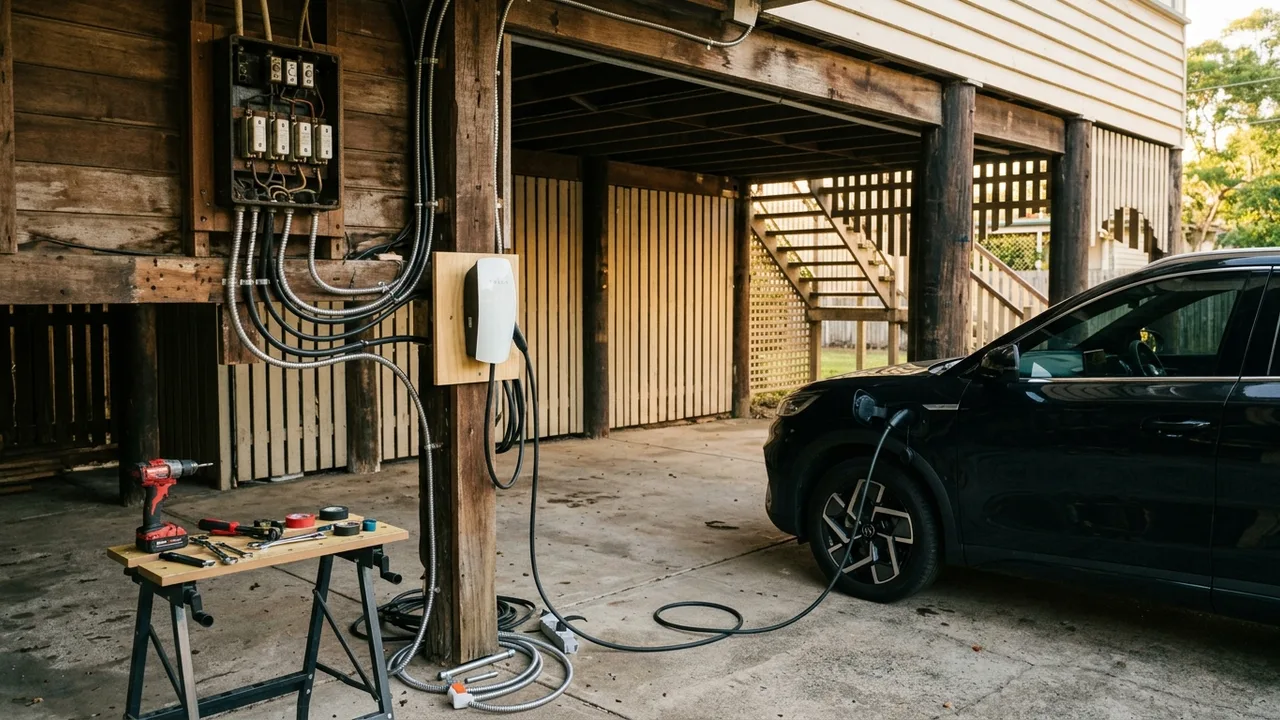
In older homes in Herston or Bowen Hills, the sub-floor may be partially blocked by later additions, concrete infill, or decades of built-up debris. Access hatches may be too small for a tradesperson to move through comfortably. The bearers and joists may be in a configuration that forces the cable to take a long, indirect route.
None of this is visible on a site visit unless your electrician actually gets under the house and looks. A quote prepared without that inspection is a rough estimate, not a firm price. When you are getting quotes for EV charger installation on a Queenslander, insist the electrician inspects the sub-floor and the switchboard before they put a number on paper.
Existing Wiring: When You Cannot Just Piggyback
Some Queenslander owners find an existing power outlet in the garage and assume they can plug a standard charger in while they wait for a proper installation. You can use a standard 10-amp outlet with a trickle charger in the short term, but it is genuinely slow (around 2.4 kW) and it puts sustained load on wiring that may not have been designed for it.
More importantly, if that garage circuit runs back through old rubber-insulated wiring, adding any sustained heavy load creates a fire risk. A licensed electrician will assess the condition of the wiring when they inspect. If they say the existing circuit cannot support it, take that seriously.
The alternative some owners choose is a smart charger with built-in load management, which throttles the charge rate to avoid overloading the available supply. This is a genuine option and works well in homes where the switchboard is modern enough to support a dedicated circuit but the overall capacity is limited. It does slow charging compared to a full 32-amp dedicated circuit, but it is a reasonable trade-off if the alternative is a full switchboard upgrade you are not ready for.
Solar Integration in a Queenslander: Real Benefits, Real Conditions
Inner North Brisbane gets excellent solar exposure, and a lot of the Queenslanders we work on in suburbs like Wilston, Albion and Teneriffe already have rooftop photovoltaic (PV) systems. Connecting a smart EV charger to your solar system so it prioritises charging from excess solar generation is one of the better value propositions in home energy management right now.
The practicality depends on a few things. Your inverter needs to have an API or CT clamp output that the smart charger can read. Older string inverters may not support this. If your system is more than eight years old, it is worth checking the inverter model before you invest in a solar-integrated smart charger.
The cable routing issue does not go away with solar integration. The charger still needs a dedicated circuit back to the switchboard, and the EV charger and solar monitoring need to communicate, either via your home Wi-Fi network or a direct wired connection. In a large Queenslander block, Wi-Fi coverage in the detached garage can be unreliable, which sometimes means a separate Wi-Fi access point in the garage.
What a Realistic Budget Looks Like
There is no single answer, but here is an honest range for a typical Queenslander installation in inner Brisbane:
- Charger supply and install (straightforward, attached garage, modern switchboard): $1,800 to $2,500
- Charger supply and install with switchboard upgrade: $3,000 to $5,000
- Charger supply and install with sub-floor run to detached garage: $2,500 to $3,800
- Full scope (switchboard upgrade, long cable run, detached garage, outdoor-rated charger): $4,500 to $7,000 or more in complex cases
These are indicative ranges for Brisbane in 2025. Your actual quote will depend on the specific property, the charger model selected, and conditions on the day.
Every job we complete includes a Certificate of Compliance for Electrical Work (CCEW), which is a legal requirement in Queensland for any new circuit installation. Do not use an electrician who does not provide this.
A Straightforward Closing Thought
If you own a Queenslander and you are planning an EV purchase, book the electrical inspection before the car arrives. That gives you time to plan the work, budget accurately, and avoid the situation where your new car is sitting in the driveway while you wait three weeks for a switchboard upgrade.
The installation is very much achievable on virtually any Queenslander property. It just takes a proper assessment to know what you are actually dealing with. We cover Newstead, New Farm, Wilston, Windsor, Albion, Teneriffe, Herston and Bowen Hills, and we are happy to come out and give you an honest site assessment before you commit to anything.
Quick answers