EV Charger Installation guide
Does Pairing Solar With Your EV Charger Actually Save Money in Brisbane?
Does Pairing Solar With Your EV Charger Actually Save Money in Brisbane?
Yes, pairing solar with a home EV charger can save you real money in Brisbane, but the size of that saving depends on a few things you need to understand before assuming the maths works out automatically. It is not a guaranteed win for every household, and the honest answer involves some trade-offs worth knowing about.
How the Savings Actually Work
The basic logic is straightforward. Your solar panels generate electricity during the day. Your car sits in your garage or carport doing nothing. If you can push that free (or near-free) solar energy into your EV's battery rather than exporting it to the grid for a few cents, you are substituting cheap self-generated power for grid electricity that typically costs 25 to 35 cents per kilowatt-hour (kWh) in south-east Queensland.
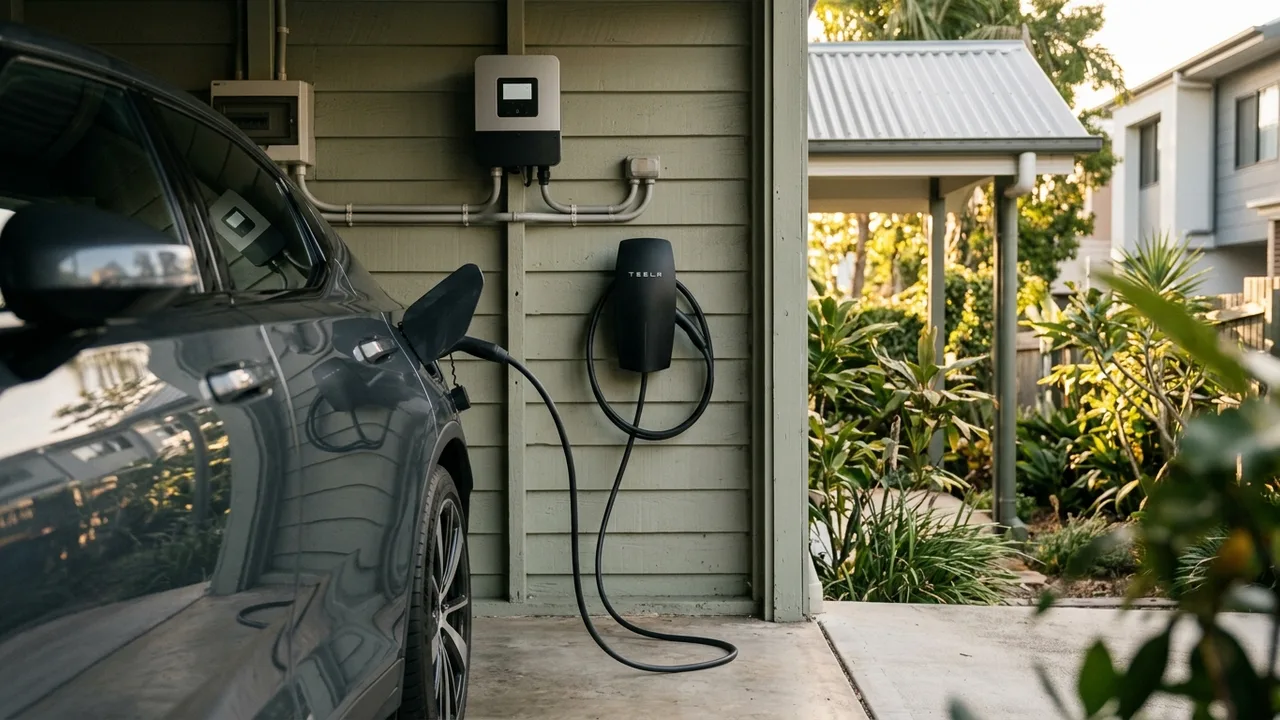
A typical mid-size EV consumes around 18 to 22 kWh per 100 km of driving. If you drive 50 km a day, you are adding roughly 10 to 12 kWh back into the battery each charge cycle. At grid rates, that is $2.50 to $4.20 per day. Over a year, you are looking at $900 to $1,500 in charging costs if you rely entirely on the grid. Offset most of that with solar, and the saving is meaningful, not just theoretical.
The catch is that most people are not at home during peak solar hours (roughly 9 am to 3 pm). The car is not plugged in. Or if it is, standard chargers do not automatically throttle their draw to match live solar production unless you have a solar-aware charger and the right setup.
Brisbane's Solar Profile and Why It Helps Here
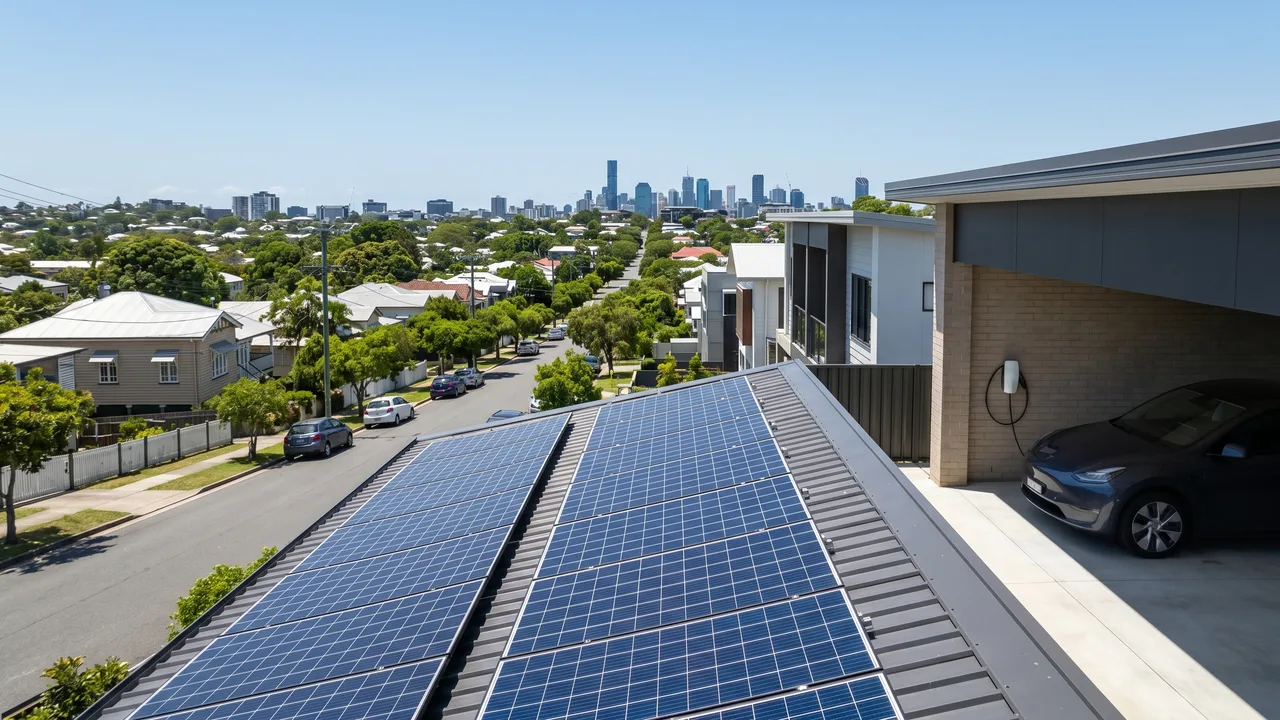
Brisbane gets a lot of sun. Inland suburbs like Wilston, Windsor, and Albion typically see around 5 to 5.5 peak sun hours per day averaged across the year, which is genuinely high by Australian standards. Even accounting for the occasional overcast week in June or a bout of summer storms, solar generation in this part of Queensland is consistent enough to make the maths work across most of the year.
Compare that to Melbourne or Hobart, and Brisbane homeowners have a real advantage. A 6.6 kW system here will typically generate 26 to 30 kWh on a clear day. If your EV only needs 10 to 15 kWh to top up, there is usually enough headroom to charge the car and cover household loads without touching the grid, at least in the warmer months.
Bayside suburbs deal with some salt-air corrosion on outdoor equipment, which is worth noting if your charger or switchboard is in an exposed position. The inner-west and near-north suburbs (Newstead, Teneriffe, New Farm, Herston) do not carry that same corrosion risk, so equipment longevity is less of a concern there.
The Solar-Aware Charger Question
This is where the setup matters more than people realise. A basic Level 2 wall charger, sometimes called an AC home charger, draws a fixed load, typically 7.2 kW or 11 kW, regardless of how much solar is available at any given moment. It does not know or care whether the sun is shining.
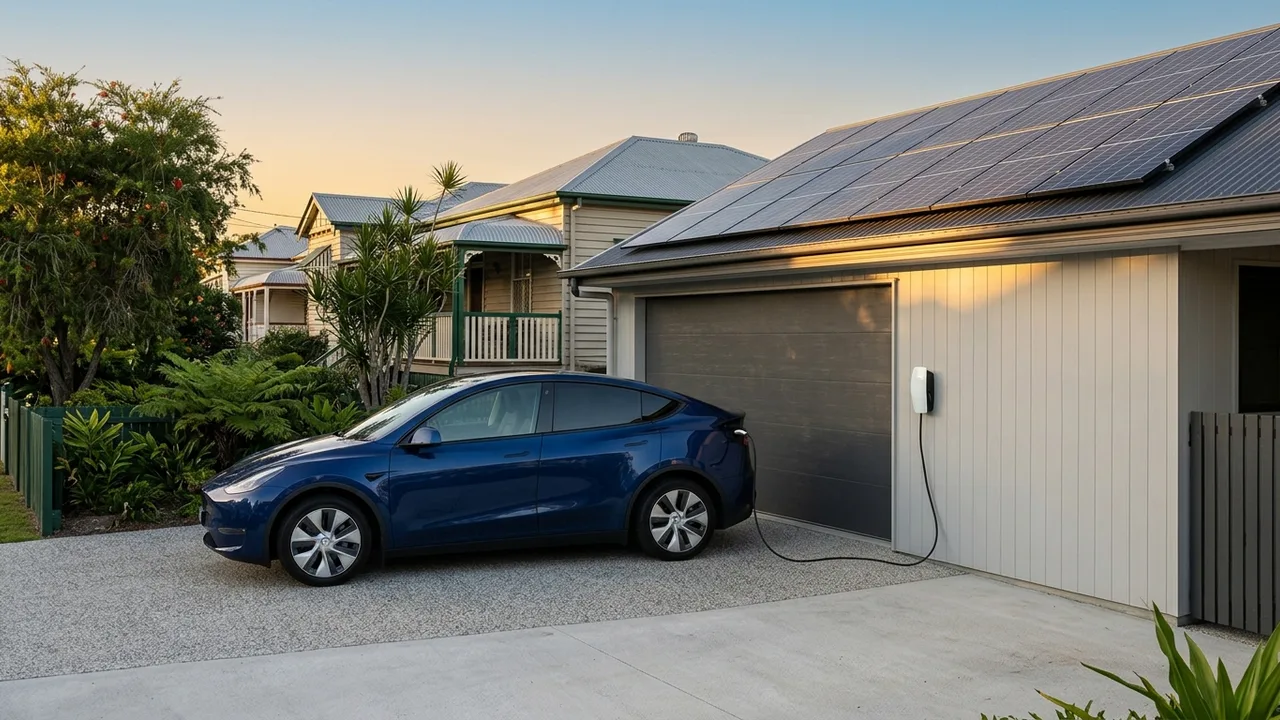
A solar-aware, or solar-integrated, charger can communicate with your inverter (or a home energy management system) and modulate its charge rate in real time. When solar production is high and household loads are low, it pushes more power to the car. When a cloud rolls over or the washing machine kicks on, it backs off. Some units can work purely on solar surplus, so the car only charges when there is excess generation, not when you would be drawing from the grid.
The trade-off is cost. A basic Level 2 charger and installation in a typical Newstead or Windsor home might come to $1,800 to $2,500 depending on switchboard condition and run length. A solar-integrated setup with a smarter charger can push that to $2,800 to $4,000 or more. The smarter unit pays itself back faster if you are home during the day and charge regularly, but if you are out all day and only charge overnight anyway, you may not recoup the price difference quickly.
One practical middle ground: set a scheduled charge window on your car or charger to start at 10 am (when solar is typically in full swing) and stop by 2 pm. Many EVs and chargers support this natively, without any additional hardware. It is not as precise as dynamic solar tracking, but it captures a lot of the benefit at no extra cost.
Feed-In Tariffs Are Low, Which Changes the Equation
A few years ago, Queensland feed-in tariffs were high enough that exporting solar to the grid was a reasonable strategy. That has changed. Most retailers now offer between 5 and 10 cents per kWh for exported solar, while grid electricity costs 25 to 35 cents per kWh to import. That gap is the entire financial argument for solar self-consumption.
Every kWh you export is worth maybe 7 cents. Every kWh you use yourself (to charge your car, run the dishwasher, heat water) avoids a 25 to 30 cent import. The maths heavily favours self-consumption, and an EV is an excellent battery-like load to absorb that surplus. If your solar system is already producing more than your home needs during the day, adding an EV charger is one of the better ways to use that excess productively.
When the Savings Are Smaller Than Expected
There are a few situations where the solar-plus-EV story does not pan out as neatly as the headlines suggest.
You drive a lot. If you are covering 150 km or more daily, your charging needs will likely exceed what solar can reasonably supply, especially in winter or during overcast stretches. You will still save on part of your charging, but grid top-ups become a regular necessity.
Your system is undersized. A 3 kW or 4 kW system covering a household with high daytime loads (aircon, pool pump) may have little surplus left for the car. A 6.6 kW or larger system is typically where solar-EV pairing starts to make clear financial sense.
You live in an apartment. Strata properties in Bowen Hills, Teneriffe, or New Farm may not have rooftop solar at all, or shared solar arrangements that do not benefit individual car spaces directly. EV charger installation in strata buildings is something we handle regularly, but the solar integration component is often not available in those settings.
Night-time charging habits. If you plug in at 11 pm out of habit, your car charges on grid power regardless of what your solar did during the day. A simple schedule change, or a charger with a timer, fixes this without any additional hardware cost.
A Practical Recommendation
If you already have solar (6.6 kW or larger) and a garage or covered carport, the case for adding a home EV charger is solid. Even with a basic Level 2 unit, scheduling daytime charging captures a meaningful share of your solar surplus. For most Brisbane households in this situation, payback on the charger installation alone, just through fuel cost savings versus public charging or grid charging, typically sits in the two to four year range.
If you want to go further and get a solar-integrated unit that dynamically tracks your inverter output, the upfront cost is higher but the setup is genuinely smarter. It makes most sense if you are regularly home during the day, have a larger solar system, or are adding solar and a charger at the same time as part of one project.
What is not worth doing is installing a solar-aware charger on a system that is already fully consumed by household loads. The smart features are only useful when there is actual surplus to direct.
If you are weighing up the options for a Newstead, Wilston, Windsor or nearby property, we are happy to look at your setup and give you a straight answer rather than a sales pitch. Sometimes the basic charger is the right call. Sometimes the smarter integration pays off clearly. The numbers tell the story.
Quick answers