EV Charger Installation guide
Does Pairing Solar with an EV Charger Actually Save Money in Brisbane?
Does Pairing Solar with an EV Charger Actually Save Money in Brisbane?
Yes, for most Brisbane homeowners it does save money, and the savings can be meaningful over a few years. But the honest answer has conditions, and the size of the benefit depends on how you drive, when you charge, and what your solar system already does.
Here is a practical look at how the maths works, where the real savings sit, and what to watch out for before you commit.
How the Savings Stack Up: The Basic Maths
Start with what electricity costs. Most Brisbane households on a standard Energex network tariff are paying somewhere between 30 and 35 cents per kilowatt-hour (kWh) for grid power, depending on their retailer and plan. Some time-of-use plans push that higher during peak evening hours.
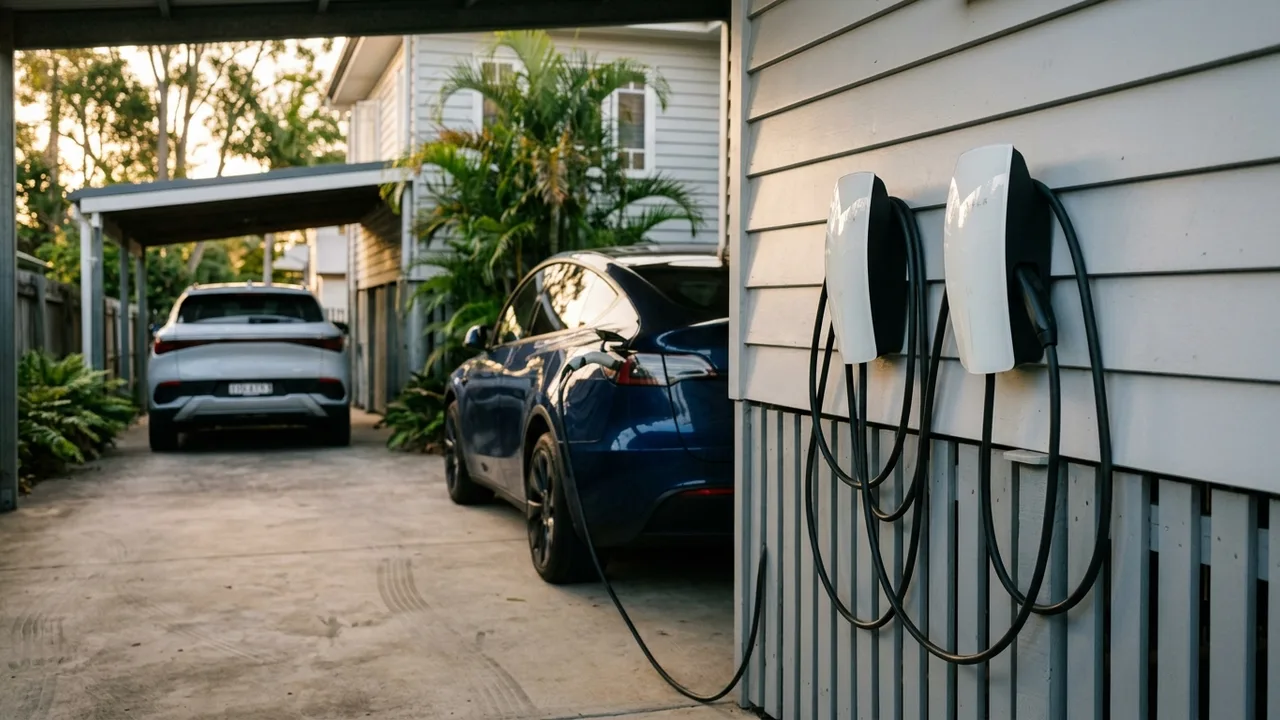
Charging a mid-sized electric vehicle, say a BYD Atto 3 or a Tesla Model 3 with a 60-75 kWh usable battery, from near-empty costs roughly $18-25 at those grid rates. If you drive an average Brisbane commute of around 40-50 km per day, you are adding maybe 8-12 kWh each day, so closer to $3-4 per day in electricity.
Now swap that grid power for solar. A typical Brisbane rooftop solar feed-in tariff is currently around 5-8 cents per kWh. That means every kWh you export earns you very little. But every kWh you divert into your car battery instead of exporting is worth 30-35 cents in avoided grid consumption. That difference, roughly 22-28 cents per kWh, is where the real saving lives. Over a year of daily 10 kWh charging, that is a saving in the range of $800-$1,000 per year, all else being equal.
The Catch: Timing and Household Load
Solar panels generate power during daylight hours. Most people drive to work, come home in the evening, and plug in their car at night. That is the opposite of when your solar is producing.
If you plug in at 7pm, you are pulling from the grid, not the sun. The solar saving disappears entirely.
This is where a smart charger earns its keep. A smart charger lets you schedule charging for the middle of the day, when your solar is typically at its peak output. If you work from home, if your car sits in the driveway while you are in the house, or if you charge on weekends, a smart charger can shift nearly all your charging load into solar hours.
Even if you do drive to work, a dual approach works well. You park at home, set the charger to start at 10am, and the car tops up while you are out. It charges from solar rather than waiting for you to get home. This is straightforward to configure on most modern smart chargers via a phone app.
What Brisbane Conditions Mean for Solar Output
Brisbane is genuinely one of the better cities in Australia for solar yield. The Inner North, including Newstead, Teneriffe, New Farm and Windsor, tends to get 5 to 5.5 peak sun hours per day on average across the year. That is higher than Melbourne and Sydney, and it translates to more usable daytime energy.
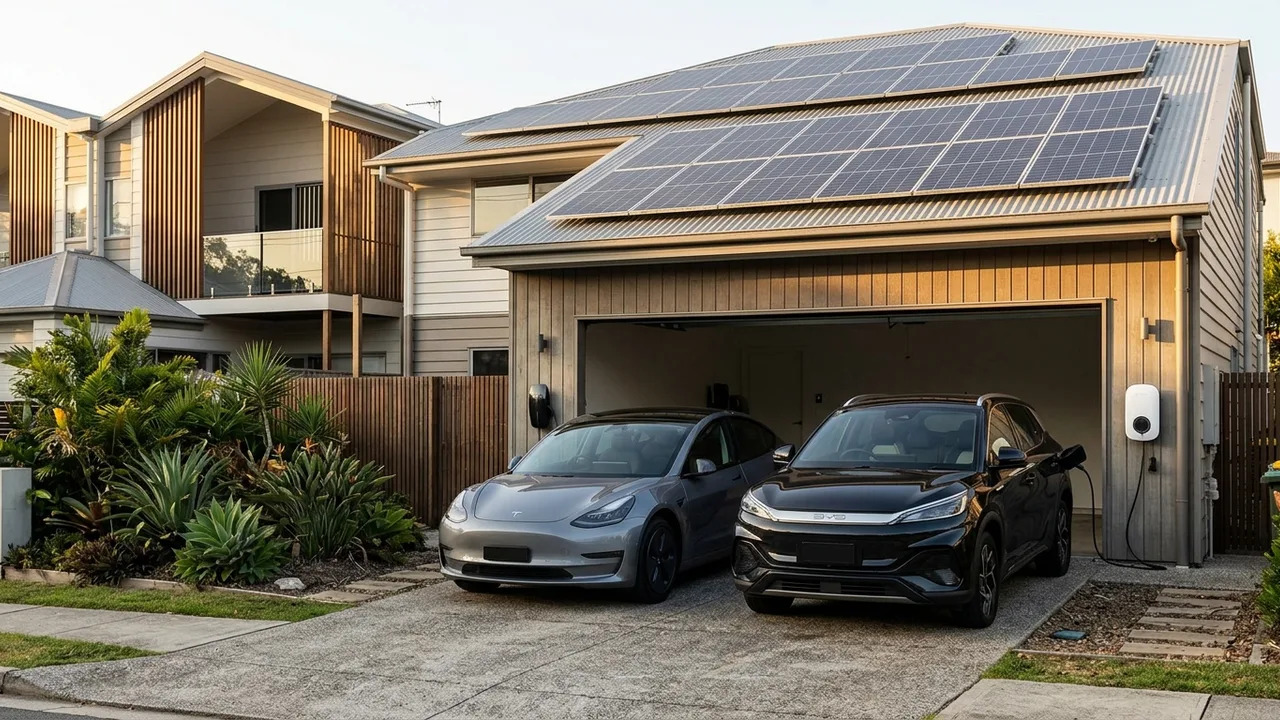
That said, a few things eat into your available surplus. Older systems in areas like Wilston or Albion often have 5-6 kW panels but older string inverters that do not always communicate with third-party chargers. Shading from large trees (poinciana and jacaranda are everywhere in this part of Brisbane) can clip output on individual panels, particularly on north-facing roofs with overhanging branches.
If your existing solar system is already running at near-full household load during the day, there may not be as much surplus as you expect for EV charging. A solar installer or your inverter's monitoring app can tell you your typical midday export figures. That number is the ceiling for free EV charging.
Queenslander Homes and Older Switchboards
A lot of the homes we work in across Windsor, Wilston, Herston and Bowen Hills are Queenslander-style timber homes. Many of them have switchboards that were last touched in the 1980s or 1990s. A dedicated Level 2 EV charger circuit typically requires a 32-amp circuit breaker and a modern safety switch (residual current device). Older ceramic fuse boards simply cannot support that safely.
A switchboard upgrade typically adds $800-$1,500 to the overall job cost, depending on the board's condition and whether the metering equipment also needs work. It is not optional, and it is not something a licensed electrician should skip. The good news is that once the board is upgraded, it benefits everything else in your home too.
For apartments and townhouses in Newstead or Teneriffe, the situation is more complex. Strata by-laws, common property switchboards and body corporate approval all factor in. These jobs take longer to organise, but they are absolutely doable.
What the Hardware Actually Costs, and When You Break Even
A mid-range smart EV charger (7 kW output, Wi-Fi connected, compatible with most solar inverter brands) typically costs $600-$900 for the unit alone. Add licensed installation, conduit, cabling, a new dedicated circuit and a compliance certificate, and a straightforward home installation in Inner North Brisbane lands between $1,800 and $3,000. Switchboard upgrades sit at the higher end of that range, or beyond it.
At a saving of $800-$1,000 per year from solar-timed charging, you are looking at a payback period of roughly two to three years for a clean installation, or three to four years if a switchboard upgrade is needed. That is a reasonable return by any standard, and it compounds: as grid electricity prices rise, the saving grows.
If you do not have solar yet, the picture shifts. You can still save with smart charging by scheduling overnight off-peak charging if your plan supports it, but the big savings come from the solar combination.
Is It Worth Doing Right Now?
The honest answer is: it depends on your situation, but the fundamentals stack up for most Inner North Brisbane households.
If you already have a solar system with consistent midday export, adding a smart charger is probably the highest-return thing you can do with that surplus energy. The feed-in tariff rewards are low; using that power yourself is far more valuable.
If your solar system is older and uses a basic inverter without data output, check whether your inverter brand supports integration with smart chargers before buying. Some older systems require a separate monitoring device or are not compatible at all without an inverter upgrade.
If you are still deciding whether to add solar at the same time as an EV charger, running both quotes in parallel makes sense. Some solar installers and EV charger electricians can co-ordinate the installation so the switchboard work is only done once.
We cover Newstead, Teneriffe, New Farm, Bowen Hills, Herston, Wilston, Windsor and Albion. If you want a clear picture of what your specific home and solar setup would actually cost to integrate, we are happy to look at it properly and give you a straight answer before any work is committed.
Quick answers