
EV Charger Installation guide
Getting Body Corporate Approval for an EV Charger in Brisbane Is Harder Than It Looks
Getting body corporate approval for an EV charger is genuinely harder than most people expect. It is not impossible, but if you own an apartment in Newstead, Teneriffe, or New Farm and you assumed you could just book an electrician and get it done in a week, you are likely in for a longer ride. Here is what the process actually looks like, where it tends to snag, and how to give yourself the best chance of getting across the line.
Why Body Corporates Have a Say at All
In Queensland, a body corporate (also called an owners corporation in other states) controls common property. That almost always includes the basement carpark, the electrical risers, and the shared switchboard. Your car space may be an exclusive-use area assigned to your lot, but the infrastructure feeding it typically belongs to the building as a whole.
This matters because installing a Level 2 EV charger, which typically draws a dedicated 32-amp circuit, is not like plugging in a toaster. It needs a permanent wiring run, often from a shared switchboard, through conduit along common property walls, to your specific bay. That work touches property the body corporate is responsible for managing.
The legal framework in Queensland is the Body Corporate and Community Management Act 1997 (BCCM Act). Under it, you generally need written approval before making any improvement that affects common property. Installing an EV charger almost always qualifies as that kind of improvement.
What the Approval Process Typically Looks Like
Most buildings handle these requests through a committee resolution or, for larger changes, a general meeting vote. The specific process depends on the building's module (Standard, Accommodation, Commercial, or Layered) and the complexity of the work.
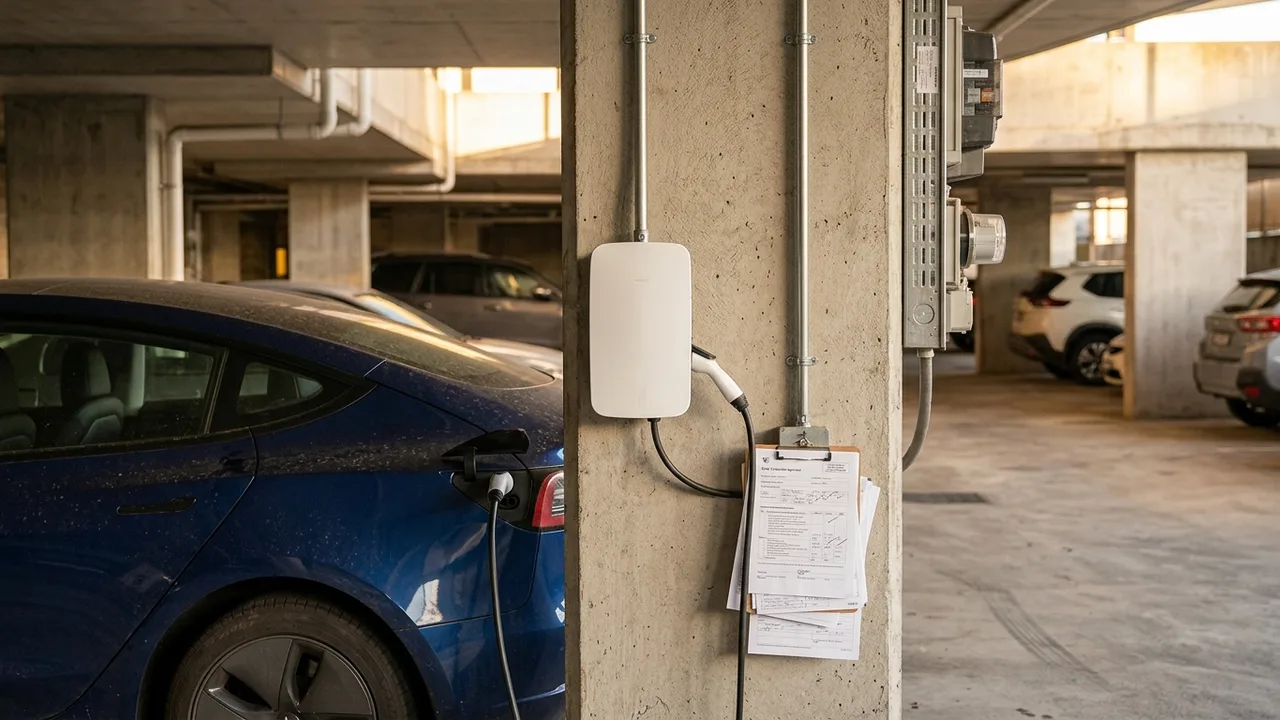
For a straightforward single-bay charger, a committee resolution is often enough. That committee can meet without calling a full building meeting, which saves time. However, the committee typically meets monthly or bi-monthly, so expect at least a four to ten week wait from when you lodge your request to when you get a decision.
If the committee escalates it to a general meeting, or if another lot owner calls for that, the timeline stretches further. General meetings in Queensland require at least 21 days notice, and the next scheduled AGM may be months away. In some buildings in Windsor or Albion, we have seen residents wait six months or more because the request kept getting pushed to the following meeting.
A solid application typically includes:
- A written request explaining the charger type, brand, and technical specs
- A proposed wiring diagram or scope of works from a licensed electrician
- Evidence that the installation will be compliant with AS/NZS 3000 and any relevant Queensland network distributor requirements
- A plan for ongoing metering (who pays for the electricity, and how)
- A statement on what happens when you sell the lot (charger stays, ownership transfers, etc.)
The metering question is one of the most contested points. Buildings with smart sub-metering can isolate your charger's consumption from the common supply. Without it, there is a real risk the body corporate ends up arguing over electricity bills for years. Proposing a clear metering solution upfront tends to reduce objections significantly.
The Electrical Reality Inside Older Brisbane Apartment Buildings
Many apartment buildings in inner Brisbane, particularly those built between the 1980s and early 2000s in suburbs like Bowen Hills, Herston, and Wilston, were not wired with EV charging in mind. That sounds obvious, but the implications are worth understanding.
The shared basement switchboard may already be operating close to its rated capacity. Adding one or more high-draw circuits can require a switchboard upgrade, which becomes a negotiation between you, the body corporate, and sometimes the building's strata manager. That upgrade cost is usually shared or passed back to the lot owner requesting the work, and it can add $1,500 to $3,000 or more to the project before a single charger goes on the wall.
Load management is a related issue. Some newer chargers include dynamic load balancing, which throttles the charge rate if the building's overall demand spikes. Proposing a charger with this feature can sometimes reduce the body corporate's concern about electrical overload, which helps the application move faster.
What Body Corporates Are Worried About (and How to Address It)
In our experience working across Newstead, Teneriffe, and New Farm, the objections tend to cluster around a few themes.
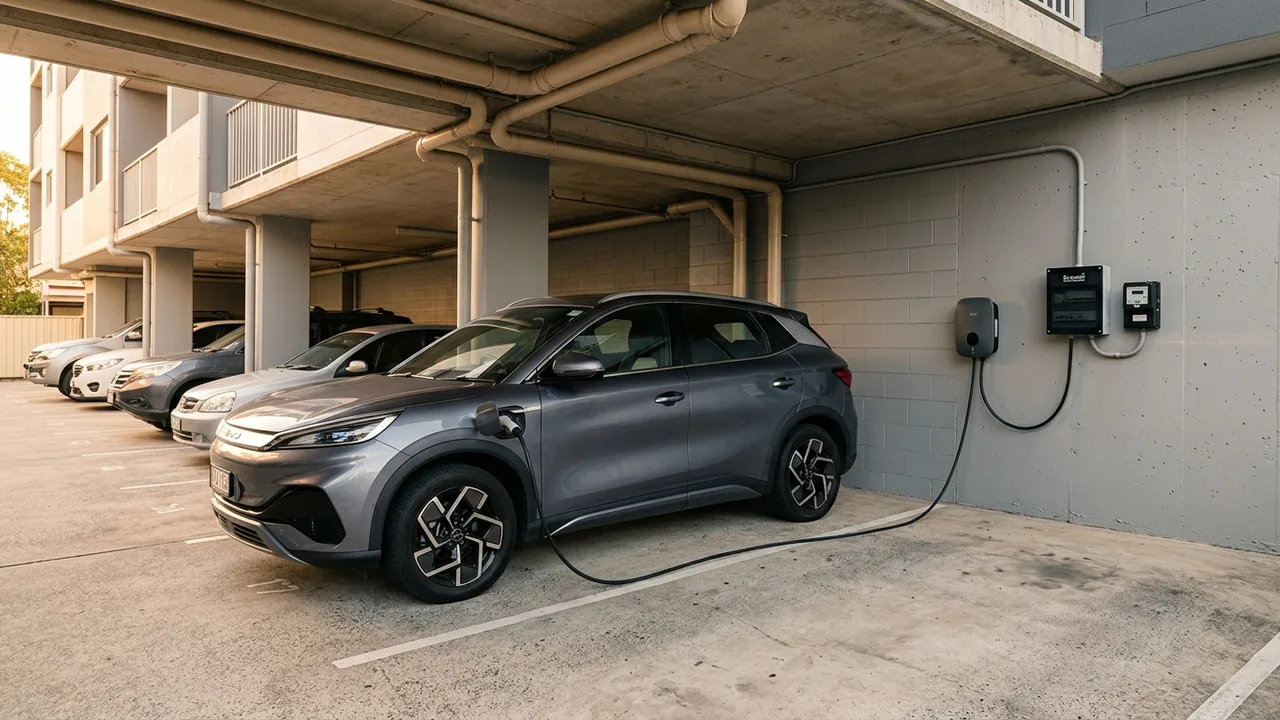
Liability and safety. The body corporate does not want a fire risk. Providing a quote from a licensed Queensland electrician, naming the certified charger brand and model, and confirming the installation will be inspected and compliant tends to address this directly.
Precedent. If the body corporate approves your charger, they may worry every other lot owner will want one. A thoughtful application acknowledges this and suggests the building adopt a general EV charger policy, which actually makes the committee's job easier in the long run. Some strata managers actively appreciate this approach.
Cost to common property. If the install requires upgrades to common infrastructure, the committee will want clarity on who pays. Put this in writing before you are asked.
Aesthetics. Less common in basements, but some buildings care about how conduit runs look in shared areas. Offering to use concealed or tidy conduit installation can remove this objection.
The DIY Temptation (and Why It Is a Bad Idea Here)
Some apartment owners, frustrated with the wait, consider running a standard power outlet to their car space and using a portable 10-amp charger. This is technically slower, adds 10 to 15 hours to a full charge on most EVs, and is often not permitted under the body corporate's by-laws for permanent installations. It also does not give you the convenience of a proper wall-mounted unit.
More importantly, if you do electrical work in a strata building without approval and without the right permits, you expose yourself to personal liability and can create real problems when you try to sell the lot. A buyer's conveyancer or building inspector will notice an unpermitted installation.
The smarter approach is to get the paperwork right first, even if it takes longer.
Practical Steps to Move Your Application Forward
If you are at the start of this process, here is a sequence that tends to work.
First, read your building's by-laws. Some buildings in inner Brisbane already have an EV charger policy. If yours does, follow it exactly; it will be faster than trying to create a new precedent.
Second, engage your strata manager before you lodge a formal request. A five-minute conversation can tell you which committee members are likely to be supportive and what format the committee prefers for technical proposals.
Third, get a written scope and quote from a licensed electrician before you submit. Committees respond better to specific plans than vague requests. A quote that includes a load assessment, proposed circuit route, metering solution, and compliance notes gives the committee something concrete to evaluate.
Fourth, be patient but persistent. Follow up politely after each meeting. Ask for the minutes if you are not getting updates.
A Closing Word
This process is genuinely cumbersome. It was not designed with EV charging in mind, and Queensland is still catching up. A few state governments in Australia have introduced "right to charge" legislation that simplifies strata EV approvals, and there is ongoing advocacy for Queensland to follow. As of mid-2025, that reform has not arrived here yet, so the body corporate approval route remains the only legitimate path.
If you are in Newstead, Teneriffe, New Farm, or any of the surrounding suburbs and you want to know what a compliant installation would actually require in your specific building, we are happy to have a look and put together a scope you can take to your body corporate committee. That conversation costs you nothing, and having a real quote in hand almost always speeds up the approval process.
Quick answers