EV Charger Installation guide
Is Your Switchboard Too Old to Handle an EV Charger?
Is Your Switchboard Too Old to Handle an EV Charger?
Possibly, yes. Many homes in Brisbane's inner suburbs are running on switchboards installed in the 1970s, 80s, or even earlier, and those boards were never designed to carry a dedicated 32-amp EV charging circuit. The good news is that finding out is straightforward, and the fix is usually a one-day job.
What an EV Charger Actually Demands from Your Switchboard
A wall-mounted Level 2 charger (the kind that gives you 40 to 80 kilometres of range per hour) typically draws between 16 and 32 amps continuously. That is not a spike load like a kettle. It runs steadily for four to ten hours, often overnight.
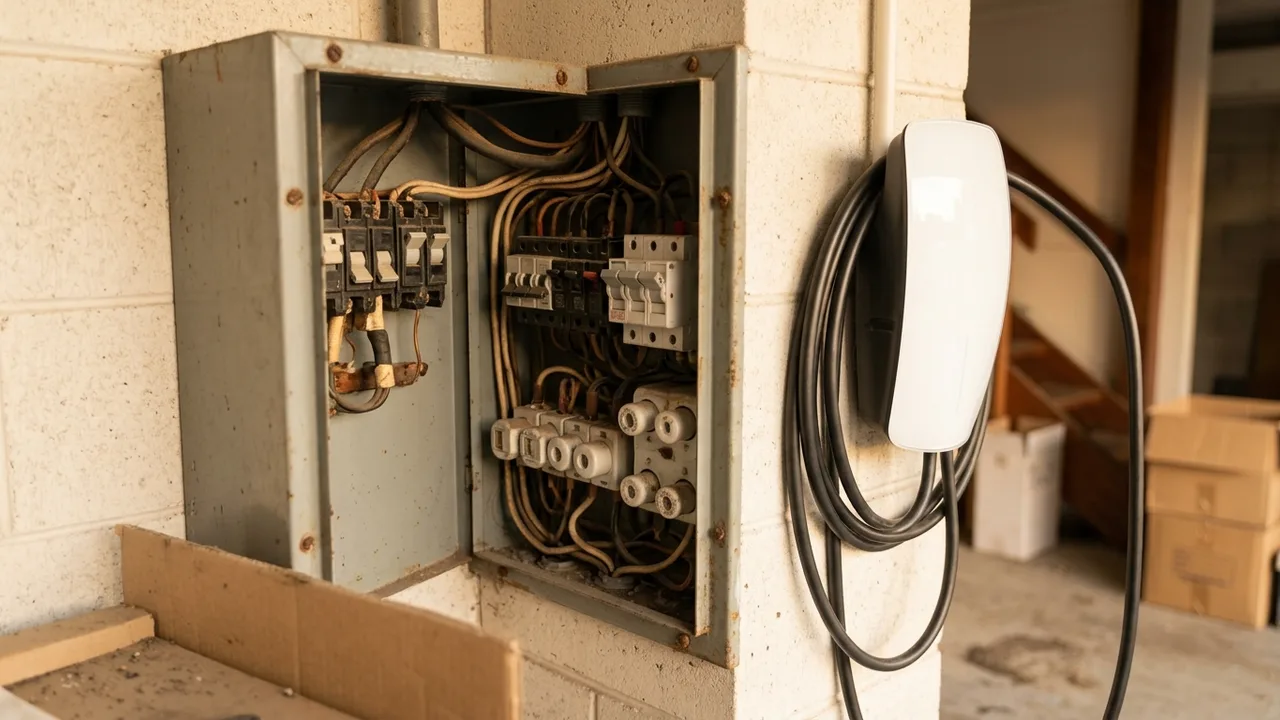
Your switchboard needs to handle that in two ways. First, it needs a spare circuit breaker slot (or "pole") to take a dedicated circuit. Second, the whole board needs to be able to handle the additional load without tripping other circuits or running at a current that degrades the wiring.
Most modern switchboards installed in the last 15 years or so can handle this with a straightforward circuit addition. Older boards often cannot, for reasons we will get into below.
The Warning Signs in an Older Switchboard
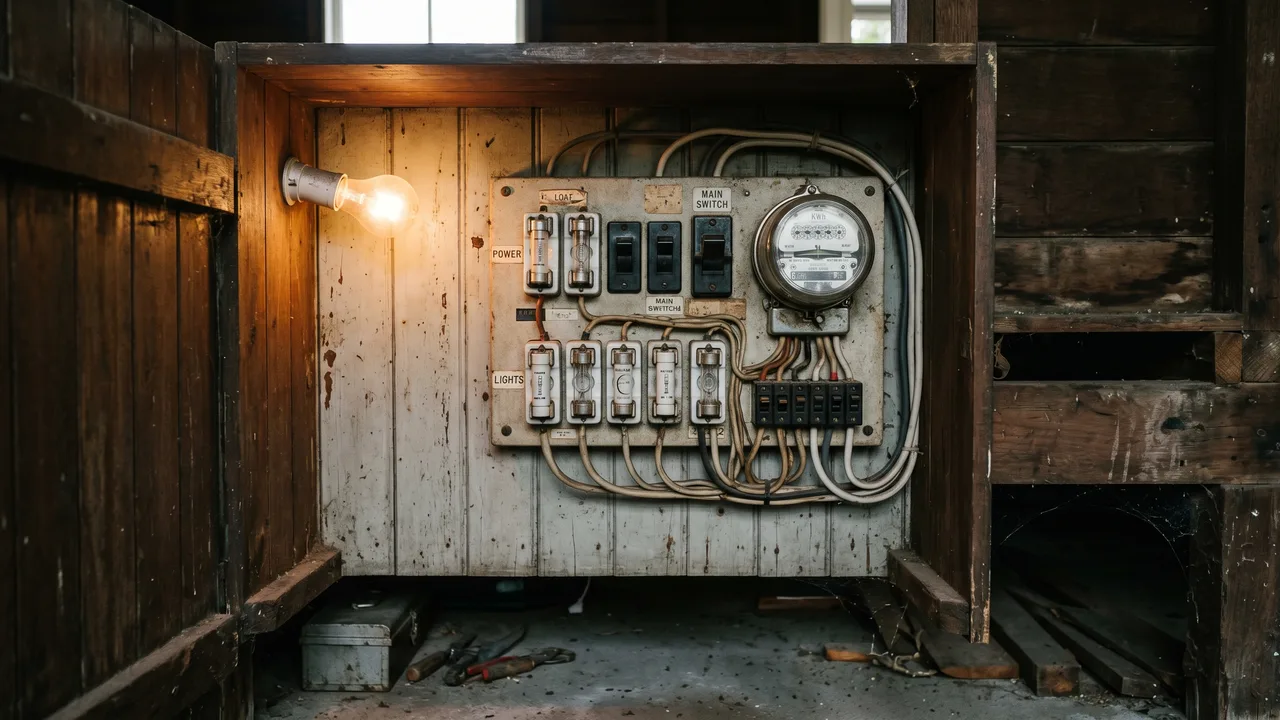
The clearest red flag is ceramic fuses rather than circuit breakers. If you open your switchboard and see a row of porcelain or ceramic fuse holders with rewirable fuse wire, that board pre-dates safety switch requirements and almost certainly pre-dates the load demands of modern households. Adding an EV charger to it would be unsafe and non-compliant under Queensland electrical standards.
Other warning signs include:
- No residual current device (RCD), sometimes called a safety switch. Queensland rules require these, and an EV charger circuit must have one.
- A board that is already running hot or showing scorch marks around terminals.
- No spare poles. If every slot is occupied, there is nowhere to add a new circuit.
- Old wiring that runs from the board through the wall in single-insulated cloth or rubber sheathing. This is common in Queenslander-style homes across Wilston, Windsor, and parts of New Farm.
If you see any of these, a licensed electrician should inspect the board before any new circuit work begins.
The Inner Brisbane Context: Queenslanders and Older Builds
Suburbs like Wilston, Windsor, Albion, Herston, and New Farm have a high concentration of pre-1960s homes, many of them timber Queenslanders or early brick cottages. These homes are charming, but their electrical infrastructure was designed for a household load that might have been 20 amps in total. Today, with air conditioning, induction cooktops, hot water heat pumps, and now an EV, the load profile looks very different.
In Newstead, Teneriffe, and Bowen Hills, the picture is more mixed. There are plenty of post-2000 townhouses and apartments with modern switchboards, alongside older worker's cottages that have been renovated at the surface level but never had their switchboards touched.
A renovation does not automatically mean a switchboard upgrade. We have quoted jobs in Teneriffe where a beautifully renovated kitchen sat behind a 1980s switchboard with no RCD and a board that was at capacity. The renovation had added a new oven circuit, a new dishwasher circuit, and ducted air conditioning, leaving the board genuinely full.
This matters because Queensland's electrical safety rules (enforced by the Electrical Safety Office) require that any new circuit, including an EV charger circuit, be installed to current standards. An electrician cannot simply add a breaker to a non-compliant board and call it done.
What a Switchboard Upgrade Actually Involves (and Costs)
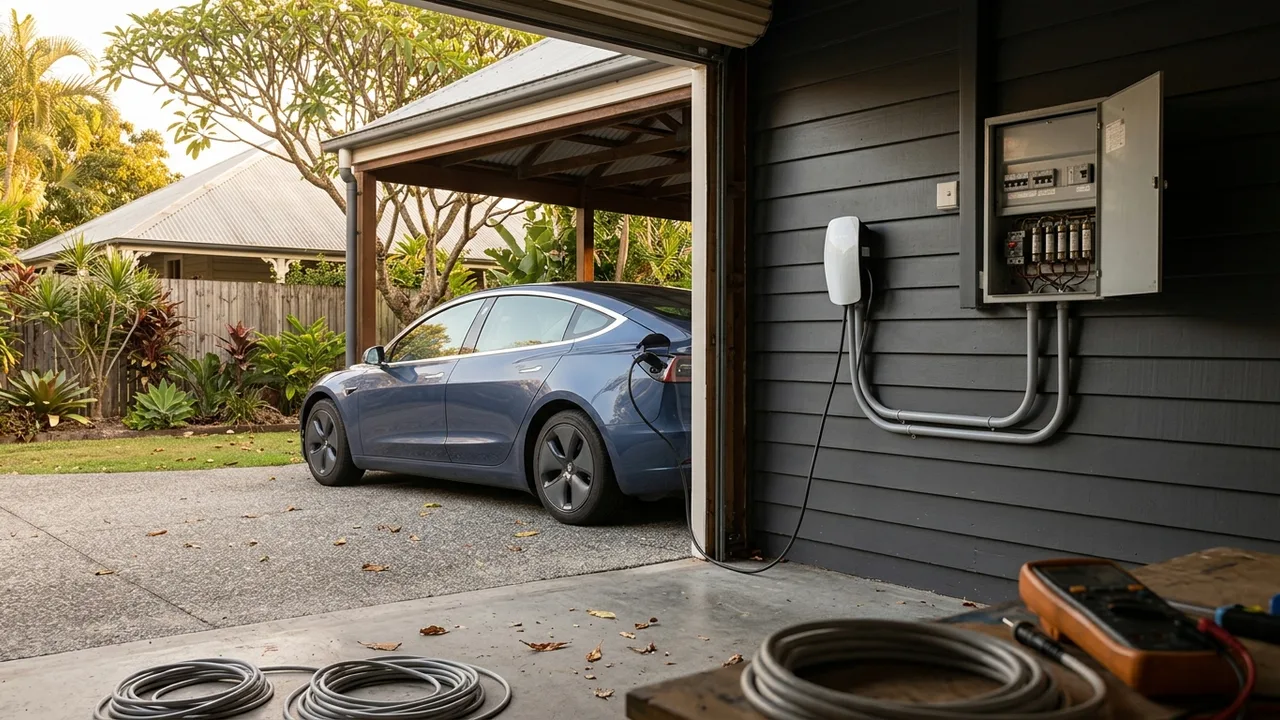
A switchboard upgrade for EV charging typically means replacing the existing board with a new consumer mains board that includes modern circuit breakers, RCDs on all circuits, and enough spare capacity for the EV charger circuit plus some future headroom.
The work usually takes one licensed electrician most of a day, sometimes two if the existing wiring needs remediation or the metering needs adjustment with Energex. The board itself, labour, certification, and the EV charger circuit typically lands somewhere in the $1,800 to $4,500 range in the Brisbane inner suburbs, depending on complexity. A straightforward board swap with the EV circuit added at the same time sits toward the lower end. Homes with old cloth wiring, unusual switchboard locations, or double-storey access challenges push toward the upper end.
Some homeowners ask whether they can just add the charger to an existing circuit (say, a 15-amp outdoor GPO). You can run some portable EV chargers from a standard outlet, but this is slower charging (typically 8 to 10 kilometres of range per hour), and a standard outlet was not designed for continuous overnight loads. It is also not a compliant installation for a permanently fixed charger. It is a workable short-term arrangement for some people, but not a substitute for a proper dedicated circuit if you are charging regularly.
Solar Integration: Does It Change the Equation?
If you have rooftop solar, you might assume the EV charger can simply run from that and bypass the switchboard question entirely. It cannot. The charger still needs its own dedicated circuit from the switchboard, complete with its own circuit breaker and RCD protection. Solar does not change the electrical safety requirements.
What solar does change is your running cost. A smart EV charger wired to communicate with your solar inverter can prioritise charging when your panels are producing surplus energy, which in a Brisbane inner-suburb home with a decent system can reduce charging costs significantly. But that integration is a software and wiring configuration that happens after the switchboard and circuit questions are resolved, not instead of them.
If you are planning to add solar and an EV charger at the same time, it is worth getting both scoped together. The switchboard work often overlaps, and doing it once is more efficient than two separate jobs.
How to Find Out Where You Stand
The honest answer is: have a licensed electrician look at your board before you commit to any charger purchase or installation quote.
Here is what that assessment should tell you:
- Whether your switchboard is safe and compliant in its current state.
- Whether it has capacity for a new 32-amp circuit.
- Whether an upgrade is needed, and roughly what that involves.
- Whether your metering or Energex connection needs attention (relevant if you are on an older single-phase connection and want a faster three-phase charger in the future).
This does not need to be a formal paid inspection in every case. When we quote EV charger installations in Newstead and the surrounding suburbs, we include a switchboard assessment as part of the site visit. If an upgrade is needed, we tell you upfront, with a clear price, before any work starts.
What you want to avoid is paying for a charger installation only to be told on the day that the switchboard is not up to it. That turns a one-day job into a two-day job and a $1,800 job into a $3,500 job, which is frustrating for everyone.
The Practical Recommendation
If your home was built after 2000 and has a modern switchboard with RCDs already fitted, there is a reasonable chance a charger circuit can be added without a full board replacement. If your home was built before 1990, especially if it has had only cosmetic renovations, treat a switchboard assessment as a necessary first step rather than an optional one.
The cost of a switchboard upgrade is real, but it is also a one-time improvement that brings your home's electrical infrastructure up to where it should be regardless of the EV charger. It adds value, improves safety, and gives you headroom for whatever else the next decade brings, whether that is a battery storage system, more air conditioning, or a second EV.
If you are in Newstead, New Farm, Wilston, Windsor, or any of the surrounding inner Brisbane suburbs and want a straight answer on whether your switchboard is ready, get in touch. We will come out, look at what you have, and give you an honest assessment.
Quick answers