EV Charger Installation guide
Does Your Switchboard Need Upgrading Before You Install an EV Charger?
Does Your Switchboard Need Upgrading Before You Install an EV Charger?
Sometimes yes, sometimes no. The honest answer depends on what's already in your switchboard, how old your home is, and what charger you plan to install. A licensed electrician can usually tell you within a few minutes of opening the board.
That said, it's worth understanding the reasoning yourself. If you know what an electrician is looking for, you can have a more useful conversation, avoid being oversold on work you don't need, and budget more accurately before you commit.
What a Home EV Charger Actually Demands from Your Electrical System
A standard Level 2 home wall charger (the kind you'd hardwire into your garage or carport) typically runs on a dedicated 32-amp, 240-volt circuit. That's roughly 7.2 kilowatts of continuous draw. "Continuous" is the key word here. Unlike a kettle or a hair dryer, an EV charger can run at close to full load for six to ten hours straight overnight.
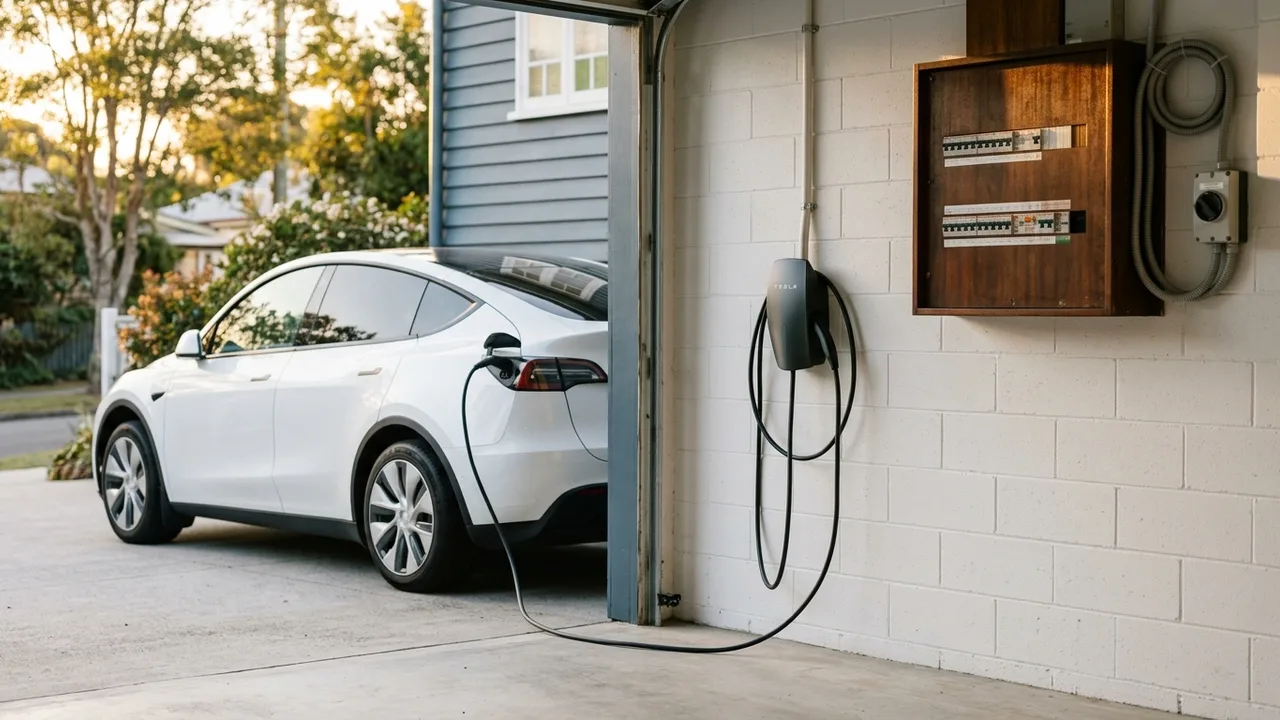
Your switchboard needs to handle that without tripping, without overheating, and without exceeding the capacity of your main supply. Most modern switchboards can manage this fine. Older ones sometimes can't, and here's why.
What Electricians Actually Look at Inside the Switchboard
When we open a switchboard to assess it for EV charger installation, we're checking a few specific things.
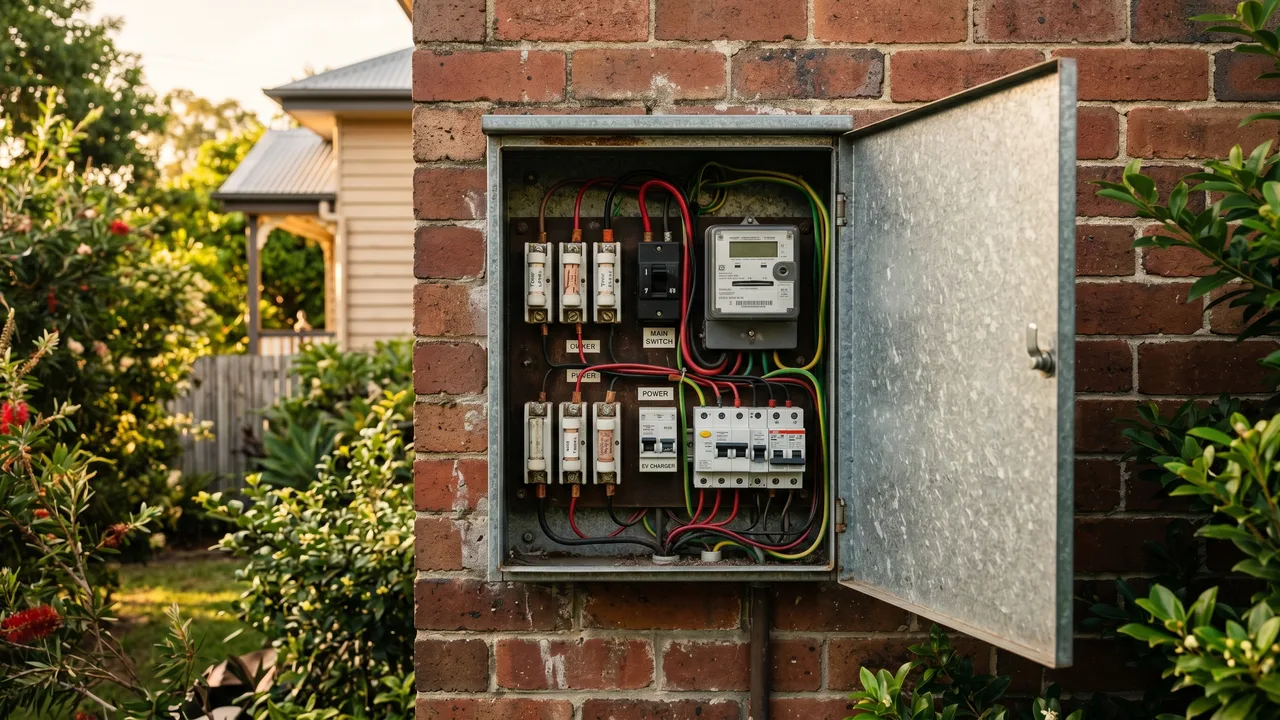
Circuit breakers vs rewirable fuses. Homes built before roughly the mid-1980s in Brisbane sometimes still have ceramic rewirable fuse holders rather than modern safety switches and circuit breakers. These are not safe for a dedicated high-draw circuit. If your board still has ceramic fuses, an upgrade is not optional.
Residual current devices (RCDs). Queensland regulations require RCD protection on all new circuits. If your board has no RCDs at all, we'll need to add at least one to cover the new EV circuit, and sometimes that triggers a more comprehensive upgrade depending on the board's configuration.
Available space for a new circuit. A dedicated EV charger needs its own breaker position. If the board is full, we either need a sub-board or a full switchboard replacement.
Main switch rating and supply capacity. Most Brisbane homes have a 63-amp or 80-amp main switch with a single-phase supply. A 32-amp charger circuit leaves enough headroom in most cases, but if you've already added a lot of other high-draw appliances (ducted air conditioning, a pool pump, a hot water heat pump), your electrician should check your overall load profile.
Condition of the board itself. Some older boards from specific manufacturers have known reliability issues. If yours is one of these, an electrician may recommend replacement regardless of EV charging, simply because it's overdue.
The Inner North Brisbane Context: Why Older Homes Come Up More Often
A large proportion of homes in suburbs like Windsor, Wilston, Albion, and New Farm are Queenslanders or post-war brick homes. These are lovely properties, but their electrical infrastructure was installed decades before anyone imagined charging a car at home overnight.
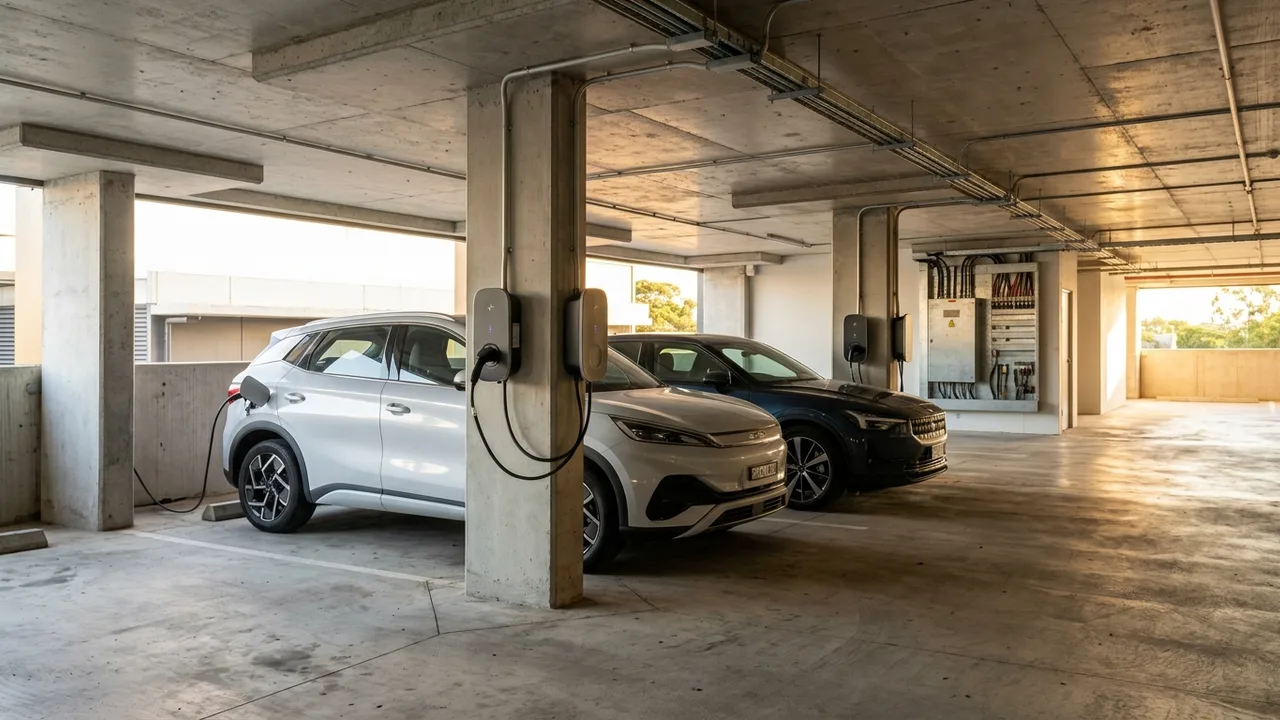
In these suburbs, we see rewirable fuse boards more often than in newer areas. We also see single-phase boards that have been patched and extended over time rather than properly upgraded. Teneriffe and Newstead have a higher proportion of apartment conversions and newer townhouses, where the boards tend to be more recent, but even there you'll find converted warehouses and older walk-ups with boards that need attention.
If your home was built before the 1990s and the switchboard hasn't been touched since, factor in the possibility of an upgrade cost. It's not guaranteed, but it's a realistic scenario.
What a Switchboard Upgrade Actually Costs (and When It's Worth It)
A switchboard upgrade in Brisbane typically runs between $800 and $2,000 depending on the complexity of the job, the size of the existing board, and whether the meter panel also needs work. When combined with EV charger installation, the total job typically falls somewhere in the $2,500 to $4,500 range for a home installation.
That can feel like a lot. But here's the trade-off worth considering: if your board genuinely needs upgrading, doing it now while the electrician is already on-site is almost always cheaper than doing it as a separate job later. You're sharing call-out time, and the work overlaps.
There's also a safety argument that goes beyond the EV charger. If your board has rewirable fuses or no RCD protection, those are hazards that exist independently of whether you ever charge a car. The EV charger just gives you a practical reason to address something that was already overdue.
What you shouldn't do is accept a switchboard upgrade recommendation without understanding why it's needed. A good electrician will show you what they found and explain what regulation or safety standard applies. If the explanation is vague, ask again or get a second opinion.
Can You Skip the Upgrade and Use a Slower Charger?
Technically, some EV owners in older homes opt for a 10-amp or 15-amp plug-in charger (sometimes called a Mode 2 or "granny charger") instead of a hardwired Level 2 unit. These draw much less current and typically don't require any switchboard changes. You plug them into an existing power point.
The trade-off is charging speed. A 10-amp charger delivers roughly 2.4 kilowatts, which adds about 15 to 20 kilometres of range per hour. If you're driving a lot each day or have a larger battery vehicle, that may not be enough overnight. You'd also be using a general-purpose circuit for something it was never designed to run continuously for hours at a stretch, which is less than ideal even if it's technically within the socket's rating.
For most people with a daily commute and a car parked overnight, a hardwired Level 2 charger is the right long-term solution. The slower option is a reasonable stopgap, not a permanent plan.
How to Approach the Decision Sensibly
Start with a proper site assessment before you commit to anything. When we quote EV charger jobs across Newstead, Bowen Hills, Herston, and the surrounding suburbs, we include a switchboard assessment as part of the quote process. You find out what your board actually needs before you sign off on any work.
If your board is fine, we'll tell you that. If it needs a minor addition (an extra RCD or a new breaker position), we'll scope that specifically. If it needs a full replacement, we'll explain why and give you a combined price.
The questions worth asking any electrician who quotes this work: What specifically did you find in the board? What regulation requires the upgrade? What happens if we don't do it?
Those three questions tend to separate a thorough assessment from a standard upsell. You deserve a straight answer to each of them.
If you'd like us to take a look at your setup and give you an honest assessment, we're straightforward about what we find. That's a reasonable starting point.
Quick answers