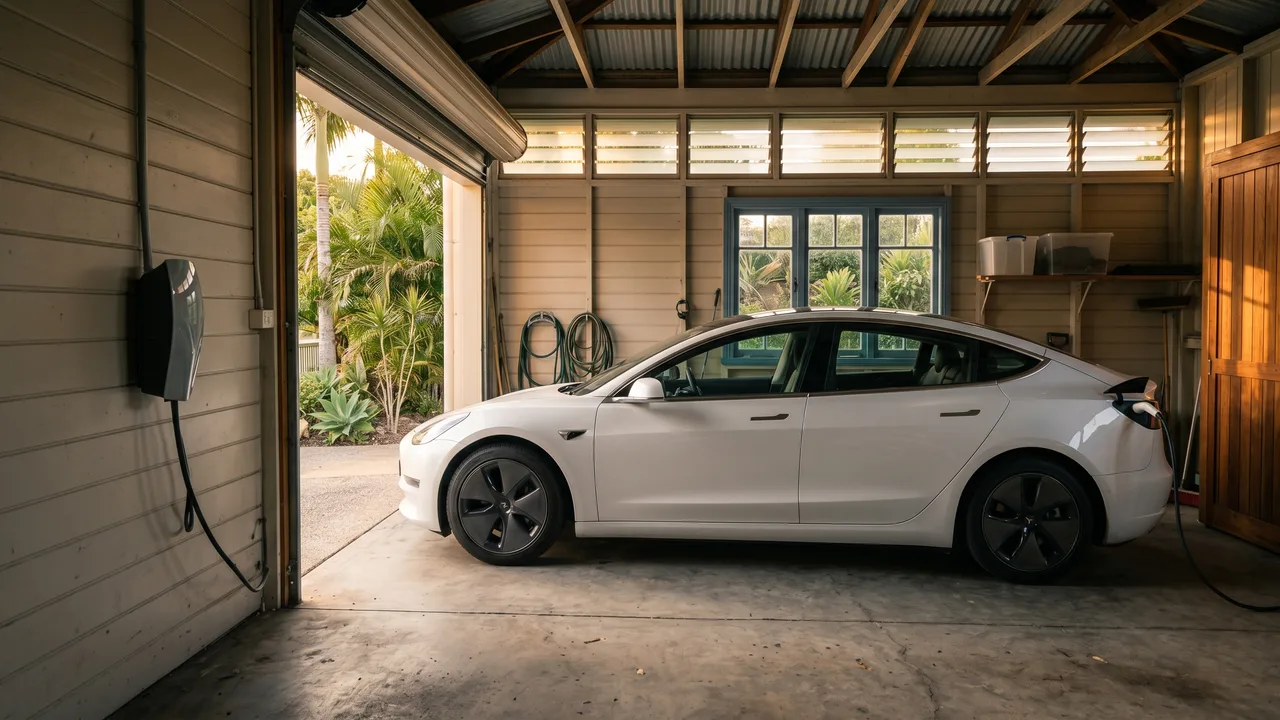
EV Charger Installation guide
What Level EV Charger Do You Actually Need for a Brisbane Home?
What Level EV Charger Do You Actually Need for a Brisbane Home?
For most Brisbane homeowners, a Level 2 charger is the right answer. It charges overnight, fits a standard garage or carport setup, and costs a fraction of what a DC fast charger would. The only real question is which Level 2 option suits your car, your daily driving distance, and your existing electrical setup.
Here's how to work that out without the sales pitch.
Level 1 vs Level 2 vs Level 3: What the Labels Actually Mean
These levels describe charging speed, which comes down to power delivery.
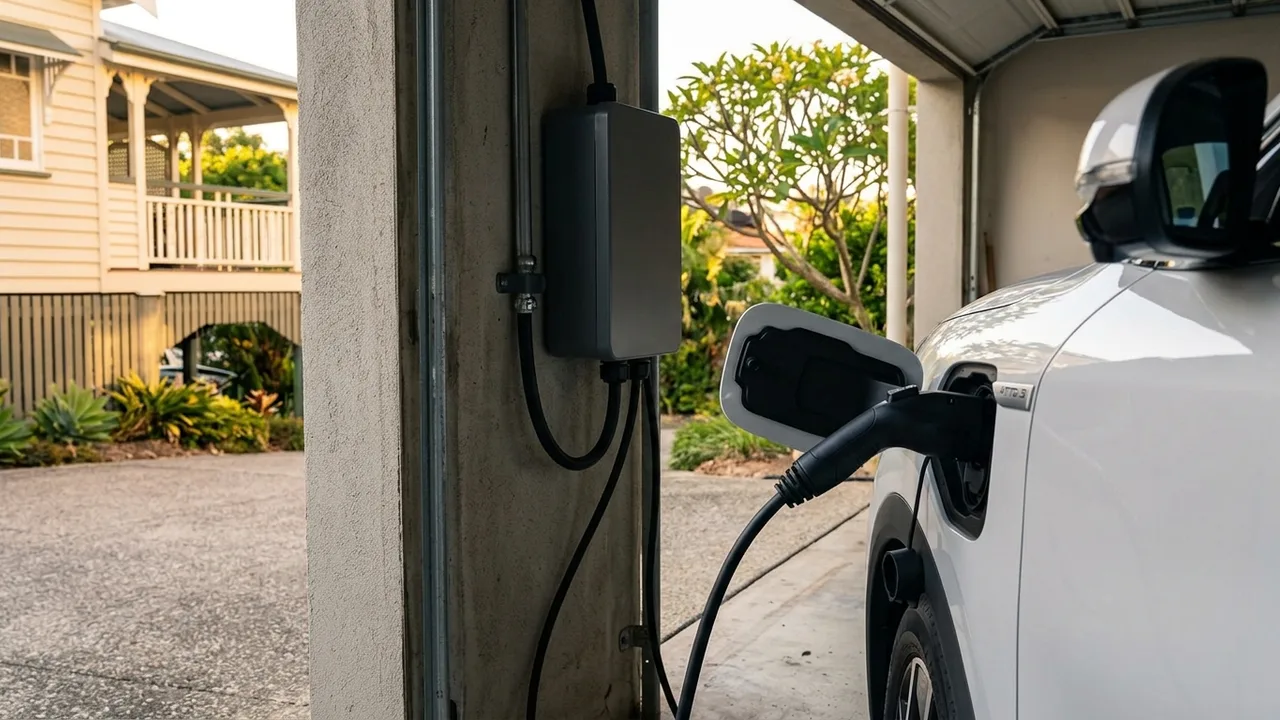
- Level 1 uses a standard 10-amp household outlet (240V in Australia). You plug in with the cable that came with your car. It adds roughly 10-15 km of range per hour. Fine for a plug-in hybrid with a small battery. Painfully slow for a full battery electric vehicle (BEV).
- Level 2 uses a dedicated 240V circuit, typically 32 amps, and adds anywhere from 25 km to 75+ km of range per hour depending on the charger and the car's onboard charger capacity. This is what most people mean when they talk about home EV charger installation.
- Level 3 (DC fast charging) delivers direct current at very high power. These are commercial roadside units. They cost tens of thousands of dollars to install, require a three-phase commercial supply, and are not a realistic home option. You don't need to think about Level 3 for a residential install.
For a Brisbane homeowner, Level 1 is too slow unless your car has a tiny battery and you rarely drive far. Level 3 is overkill and not feasible. Level 2 is what you're here for.
How Much Power Does Your Car Actually Accept?
This is where a lot of people get confused. The charger you install at home sets the maximum power available, but your car's onboard charger (AC charger) sets the maximum power it will actually use.
Some examples, roughly:
- A Nissan Leaf 40 kWh typically accepts up to 6.6 kW AC.
- A Tesla Model 3 (rear-wheel drive) accepts up to 11 kW AC.
- A BYD Atto 3 typically accepts up to 7 kW AC.
- A Hyundai Ioniq 6 can accept up to 11 kW AC.
If your car tops out at 7 kW, installing a 22 kW charger is mostly wasted money. You'd be paying for capacity you cannot use. A good 7.2 kW or 7.4 kW wall charger is sufficient and meaningfully cheaper to install and purchase.
On the other hand, if you drive 150 km most days and you own a car that accepts 11 kW, a higher-capacity charger does make a real difference to overnight recovery time.
As a rule of thumb: check your car's AC charging rate in the owner's manual or the manufacturer's specifications page, then buy a charger that matches or slightly exceeds it.
What Your Brisbane Home's Electrical Setup Actually Allows
This is the practical bit that online comparisons often skip over.
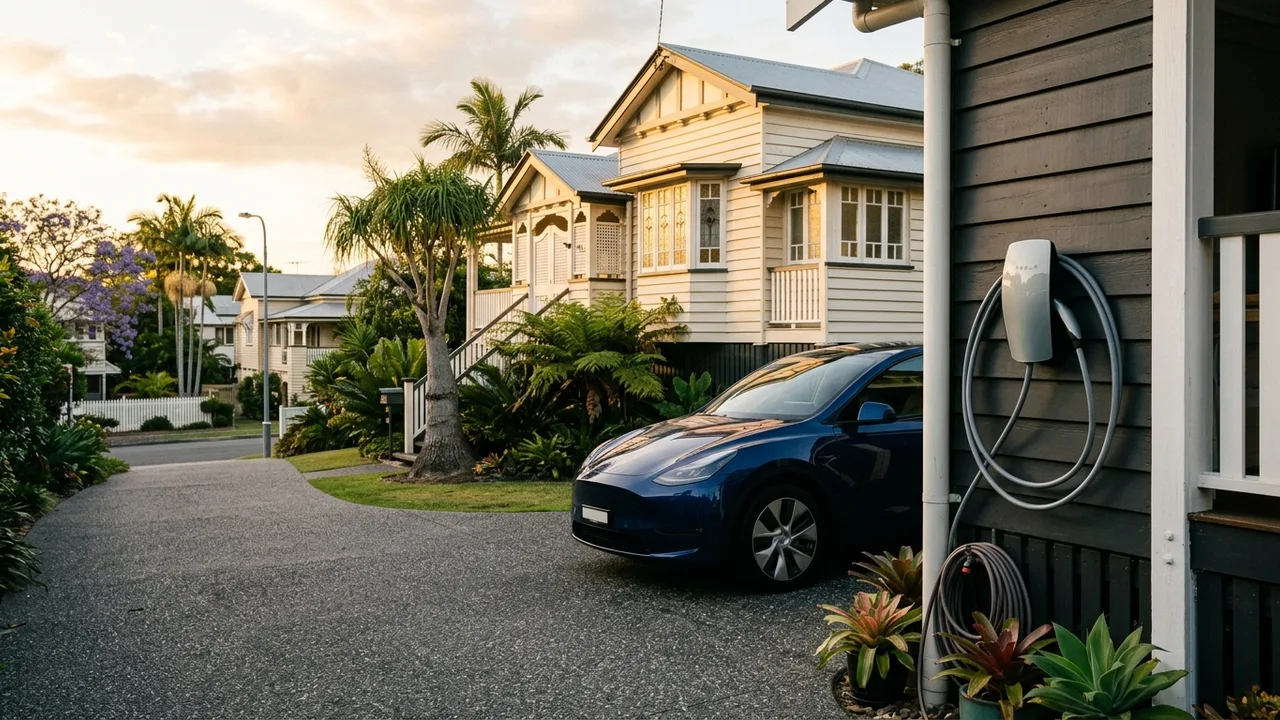
Most homes across inner Brisbane suburbs like Newstead, Teneriffe, Windsor, and Wilston have single-phase power. A single-phase 32-amp dedicated circuit is the standard home EV installation, and it delivers around 7.2-7.4 kW. That's enough for most BEVs.
Three-phase power unlocks higher charging rates (up to 22 kW for a three-phase charger), but most inner Brisbane residential properties don't have it. Some newer apartment blocks and certain larger homes do, but it's not the norm. Before you spec a 22 kW charger, have an electrician confirm your supply.
Older switchboards are the other common issue. A lot of homes in Windsor, Albion, and Herston were built in the 1960s to 1980s and still have ceramic fuse boards or early circuit breaker panels. These are not safe candidates for a dedicated 32-amp EV circuit without an upgrade first. A switchboard upgrade adds cost, typically $600-$1,200 on top of the charger installation, but it also brings your home's electrical system up to current Queensland standards. It's not optional if the existing board can't carry the load safely.
We assess switchboards as part of every quote we do across our service area, so you won't get a surprise invoice after installation day.
The Solar Integration Question
If you have rooftop solar, you have a genuinely useful option: charge your car during the day using your own generated power rather than drawing from the grid overnight.
This works best when you're home during the day or willing to set a charging schedule. Some Level 2 chargers have built-in solar optimisation modes that detect excess generation and ramp charging up and down accordingly. Others rely on a smart home energy management system to do the same job.
The payoff is real. Solar electricity in Brisbane typically costs nothing beyond the system you've already paid for, while grid electricity (especially on a time-of-use tariff) can run to 30-45 cents per kWh depending on your retailer and the time of day.
The trade-off is response time. A car charging at 1.4 kW (using only spare solar) will add about 8-10 km of range per hour. That's fine if the car sits in the driveway for eight hours on a sunny day. It's not enough if you need a fast recovery after a long drive.
We wire EV chargers to work with existing solar systems and can advise on which charger models handle solar export management well. Not every charger does it gracefully.
Apartment and Strata Installs: A Different Set of Variables
If you live in one of the apartment buildings across New Farm, Bowen Hills, or Teneriffe, the process is more involved. You're not just dealing with an electrical circuit; you're dealing with body corporate approval, common property access, metering arrangements, and potentially shared electrical infrastructure.
That said, it's very doable. Queensland strata legislation has improved in favour of EV-friendly installations, and most body corporates are becoming more receptive, particularly when the work is presented professionally with proper documentation.
The key differences for strata:
- You need body corporate approval before any work begins.
- The charger is typically installed in your allocated basement car space.
- A separate sub-meter is usually required so your electricity use is billed to your unit, not the building's common supply.
- Installation cost is typically higher than a standalone home due to cable routing distances and compliance documentation.
If you're navigating this, we can help prepare the documentation and work directly with your building's electrician or building manager.
A Straight Answer Before You Call Anyone
If you drive a standard BEV, park at home overnight, and your home is a house or townhouse with a single-phase supply: a 7.2-7.4 kW Level 2 wall charger on a dedicated 32-amp circuit is almost certainly what you need. It will charge most cars from near-empty to full overnight. It costs less than a higher-capacity unit. And it works with single-phase power, which is what most of inner Brisbane has.
If your car accepts 11 kW and you regularly need a full charge in less than eight hours, step up to an 11 kW charger, but confirm your supply and switchboard can handle it first.
If you have solar, choose a charger with genuine solar integration. The extra $100-$300 in charger cost pays back quickly.
If you're in an apartment, get the strata process started early. It takes longer than a residential install, but it's entirely achievable.
Installation costs across our Newstead and inner Brisbane service area typically run from $1,800 to $4,500 depending on the job. The spread is wide because switchboard condition, cable run length, and charger choice all move the number significantly. A site visit and a proper assessment is the only way to give you an honest figure.
If you want to talk through your specific setup before committing to anything, we're happy to do that.
Quick answers