EV Charger Installation
Solar and EV Charger Integration.
Link Your Solar to Your EV Charger
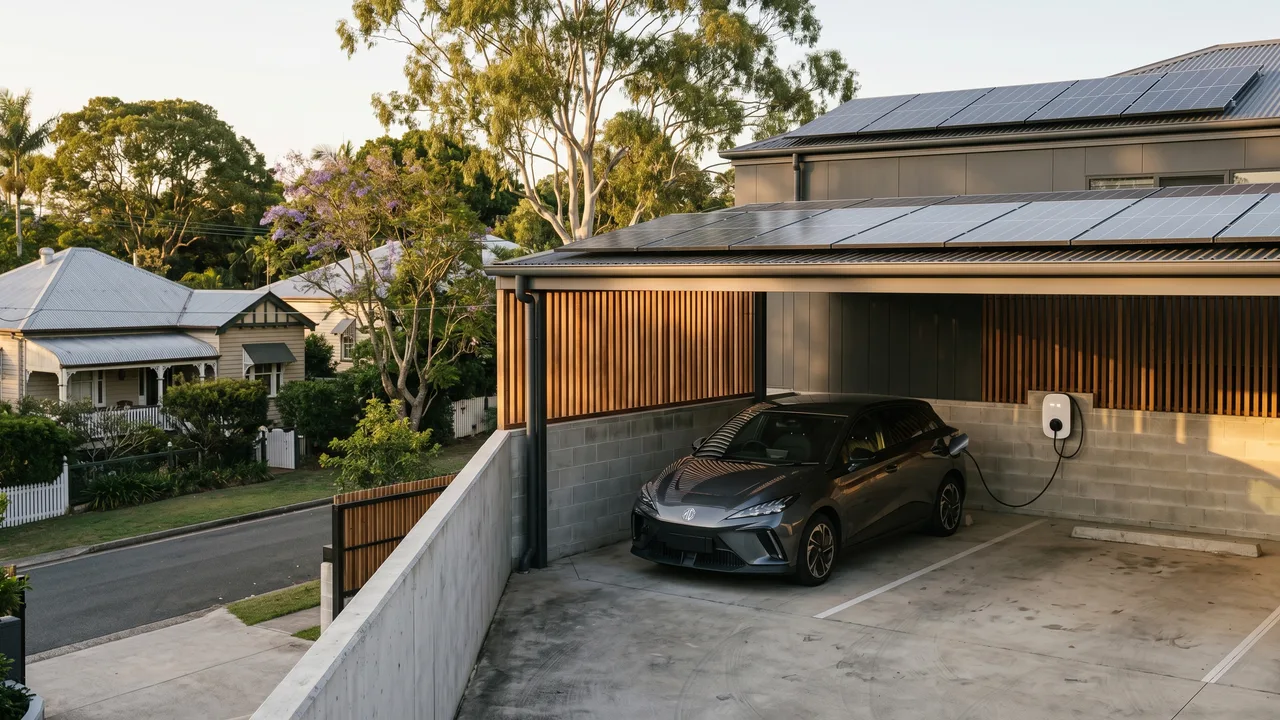
If you already have rooftop solar panels, you're generating free electricity every day. The problem is that most standard EV chargers don't know (or care) when your solar is producing. They draw from the grid whenever you plug in, day or night. Solar and EV charger integration fixes that by connecting a smart charger to your solar inverter or energy management system so your car charges on surplus solar first, and grid power only fills the gap.
This is one of the more satisfying upgrades we do in Newstead and the surrounding Inner North suburbs. The payoff is real and ongoing: lower charging costs, better use of panels you've already paid for, and a setup that actually behaves the way most people assumed their solar would work when they bought it.
What the Work Actually Involves
Integration isn't just plugging a smart charger into the wall near your inverter. The physical work typically covers:
- Installing a compatible smart EV charger (if you don't already have one) rated at 7kW or 22kW, depending on your single-phase or three-phase supply
- Running communication cabling between the charger and your solar inverter, or connecting via the inverter's CT clamp (current transformer) circuit
- Configuring the charger's solar-priority or excess-divert mode through the manufacturer's app or web portal
- Testing the feedback loop to confirm the charger ramps up and down as solar export fluctuates
- In some setups, integrating with a home energy management system (HEMS) or battery system if one is present
The exact method depends on your inverter brand. Fronius, SolarEdge, Sungrow and Goodwe each have different communication protocols. Some charger brands talk directly to specific inverters; others rely on CT clamp monitoring as a universal fallback. We assess your existing system before recommending a charger model, so compatibility isn't guesswork.
When Does a Newstead Homeowner Need This?
You're a good candidate for this service if:
- You have an existing rooftop solar system (typically 5kW or larger) and a home EV or plug-in hybrid
- You're currently charging overnight and your electricity bill hasn't dropped the way you expected after getting solar
- Your solar system exports a significant amount back to the grid during the day while the car sits in the garage or carport unused
- You work from home part of the week, or your car is parked at home during daylight hours
It's less suited to you if your car is away from home 8am to 6pm every weekday. Solar divert charging needs the vehicle present during peak generation hours, which in Brisbane typically runs from around 9am to 3pm. If that window doesn't overlap with your car's schedule, a time-of-use scheduled charger may give you a better result for less money.
What It Costs in Brisbane
For a solar integration job in Newstead and the Inner North, expect to pay roughly $1,800 to $4,500 depending on the scope. Here's what moves the price:
- Charger hardware: a basic solar-ready smart charger sits around $700 to $1,200 supplied; premium units with built-in load balancing or three-phase capability cost more
- Inverter compatibility: some inverters need a dedicated communication module or CT clamp kit ($100 to $300 extra in parts)
- Cable run length: from your switchboard to the garage, and from the charger to the inverter - longer runs mean more conduit and labour
- Switchboard condition: if your board is older or lacks a spare circuit, a partial upgrade may be needed before we can install the charger circuit safely
What's Included in a Quote, and What's Extra
Our standard quote covers supply and install of the charger, all electrical cabling and conduit to the agreed termination points, inverter communication setup, configuration and testing of solar-priority mode, and a Certificate of Compliance for the electrical work.
What can add cost after the fact: unexpected switchboard issues found during installation, concrete core drilling if your garage slab sits between the board and the charger location, or upgrades your inverter manufacturer requires to unlock the integration API. We flag these risks during the site assessment, not after the job is done.
Is This the Right Service for Your Property?
A quick self-check:
- Do you have a solar system already installed and producing? (If not, start with a standard home charger install.)
- Is your solar inverter less than roughly ten years old? Older inverters sometimes lack the communication ports needed for direct integration.
- Does your garage or carport have reasonable cable access back to the switchboard and inverter location?
- Are you on a flat-rate or time-of-use electricity tariff? (Both work, but the financial benefit calculation differs.)
If you're unsure about your inverter's compatibility, a photo of the inverter label and your switchboard sent through before a site visit can save everyone time.
A Note on Qualifications and Safety
EV charger installation and any work that connects to your solar system's electrical circuits must be carried out by a licensed electrician. In Queensland, that includes the inverter communication wiring in most configurations. The Certificate of Compliance (also called a Form 4) is a legal requirement and your record that the work meets the wiring rules. We provide this with every job. It also matters for your home insurance: uncertified electrical work can complicate a claim if something goes wrong later.
If you'd like to talk through your solar setup before booking a site visit, give us a call. We can usually tell from your inverter brand and system size whether integration is straightforward or involves extra steps.
Quick answers
Frequently asked.
Does my solar inverter need to be a specific brand to work with an EV charger?
Will solar integration actually save me money, or is it mostly marketing?
Can I integrate solar with a charger I already have installed?
Do I need a home battery to make solar EV integration work?
How long does a solar and EV charger integration job take?
Is a Certificate of Compliance included, and why does it matter?
Ready to book
Quickest is by phone.
Up-front pricing on the call. Booked in one go. No site visit needed.